Podcast: Play in new window | Download (Duration: 56:09 — 128.5MB)
Subscribe: Apple Podcasts | Spotify | Amazon Music | iHeartRadio | Email | RSS | More
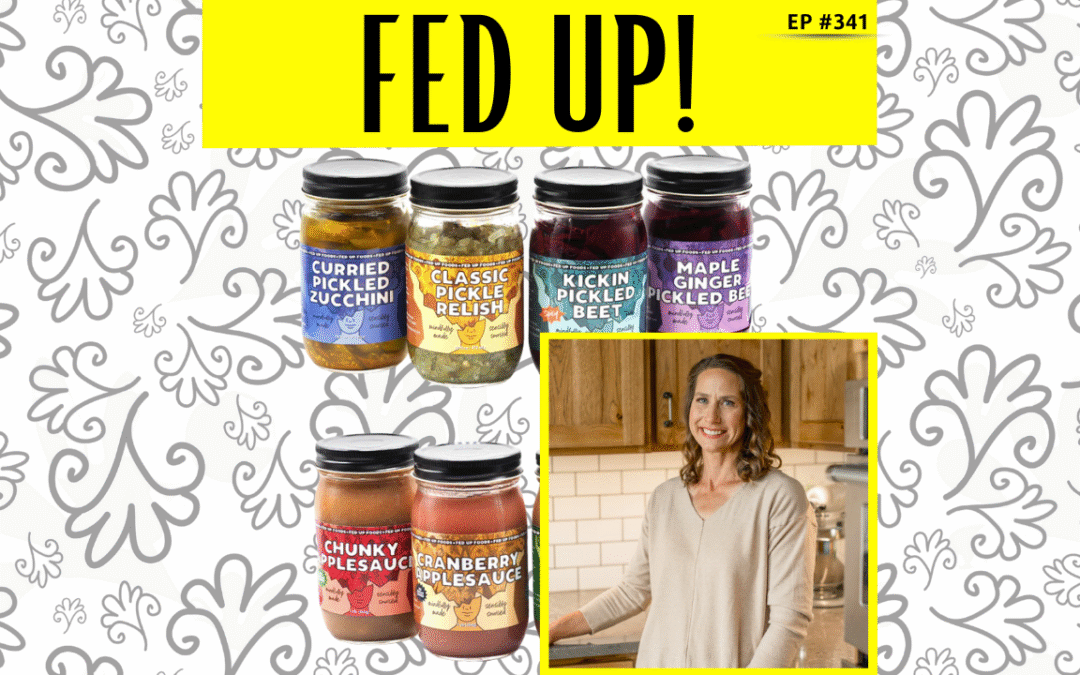
Carrie Stevens – Fed Up Foods
On the Knowing What it Takes to be Successful: “When you’re setting up your business, you want to make it convenient for the customer, but also it needs to be convenient for us because if we can’t maintain it then we’re going to get burnt out and we can’t sustain it.”
Thousands of pounds of produce goes to waste every year. This is due to many things, often having nothing to do with the actual taste or health of the produce. Sometimes it just isn’t pretty enough. So what can be done with all of this good food that should be consumed?
Carrie Stevens has a farm, butchers animals to sell and recently purchased the business named, Fed Up Foods. This is a business that takes less than pretty food and turns it into beautiful sauces, relishes and pickled produce.
Fed Up Foods got its start in the local farmers markets, thanks to Wisconsin’s pickle law. Carrie Stevens is building on that foundation to bring locally sourced, shelf-stable products—ranging from pickle relish and maple ginger beets to cranberry applesauce—to more retail shelves and customers. Discover the surprising details behind what it takes to buy and run a canned goods business, from PH testing and food safety to sourcing “imperfect” produce and managing labels and inspections.
Listen as Carrie explains her journey and what she has learned from building her sustainable food businesses.
Enjoy!
Visit Carrie at:https://www.fedupfoodswi.com/

Podcast Overview:
00:00 Woman-Owned Artisanal Canned Goods
03:41 Pickle Business Journey and Growth
09:04 Pasture Management and Livestock Rotation
10:44 Horseback Observation Resolves Calf Issues
13:23 Wisconsin Food Finance Support
17:00 “Work to Eat Philosophy”
21:21 Pickling Process and Variations
22:58 “Imperfect Produce Solutions”
27:59 “Pickled Beets Worth the Effort”
30:04 “Lard Pigs, Not Lean”
32:04 “Food Business Quality Challenges”
35:50 “Product Testing & Process Authority”
40:27 Scaling Production with Co-Packer
43:41 Cost-Effective Labeling Challenges
46:33 Frozen Meat Storage Advice
50:26 “Balancing Business and Convenience”
53:47 Cranberries: Creative Uses and Recipes
55:03 “Podcast, Support, Share Sauce”
Podcast Transcription:
Carrie Stevens [00:00:00]:
And I said, hey, why don’t you try the cranberry sauce in there? Because, you know, muddled cherries kind of look like cranberries in the cranberry sauce. And I picked them up just that day from the Mr. Ayan Rousch from Roush Century Farms in central Wisconsin. He gave me a nice little tour of his cranberry farm. Organic cranberries. Fantastic.
James Kademan [00:00:20]:
Sounds like another podcast guest. Yeah. Yes.
Carrie Stevens [00:00:22]:
So, yeah, just a little cranberry sauce in your old fashioned.
James Kademan [00:00:27]:
How about that?
Carrie Stevens [00:00:27]:
Make it the rest of the way however you like, your favorite way.
James Kademan [00:00:30]:
Foreign. Authentic Business Adventures, the business program that brings you the struggle stories and triumphant successes of business owners across the land. Downloadable audio episodes can be found in the podcast link fundedrawincustomers.com we are locally underwritten by the bank of Sun Prairie and today we’re welcoming slash preparing to learn from Carrie Stevens of Fed Up Foods. Carrie, I’m so freaking excited. We’re talking about food, which is always good.
Carrie Stevens [00:01:00]:
Always good.
James Kademan [00:01:01]:
We’re talking about pickles, which is always good.
Carrie Stevens [00:01:02]:
Absolutely.
James Kademan [00:01:03]:
And we’re talking business. So I feel like we got the trifecta here.
Carrie Stevens [00:01:06]:
Yeah, absolutely.
James Kademan [00:01:07]:
How’s it going today?
Carrie Stevens [00:01:08]:
Good, good.
James Kademan [00:01:09]:
All right, tell us the story. What is Fed Up Foods?
Carrie Stevens [00:01:12]:
So Fed Up Foods is a woman owned Wisconsin based artisanal canned goods company. So I purchased the business this past August. So I’m fairly new to it. However, it has been around for about five years. So it was started by a woman in central Wisconsin and her, her background, she was a produce buyer at the food co op and, and kind of different roles like that, very involved in the farmer’s market and she saw a lot of produce going to waste and that was bothersome to her. Well, you know, and if you, we also own a farm, I’ll talk about that more. But for a while I was getting produce from the grocery store, feeding it to our animals when it’s, you know, there’s a lot of beautiful produce, but you know, what happens to that produce after they can’t sell it anymore.
James Kademan [00:02:03]:
So you would get the stuff that was blem essentially or just didn’t look pretty.
Carrie Stevens [00:02:07]:
Yeah, or it was too, you know, I had been there for a couple weeks and it was okay, it was going mushy or whatever.
James Kademan [00:02:14]:
Pigs like it, humans don’t love it.
Carrie Stevens [00:02:15]:
Right, all right. Yeah. And humans go, so, so anyways, what do you do with that, that produce as it’s going bad or almost going bad and it’s not selling? So the previous owner had started with Doing some home canning, home pickling. And in Wisconsin there’s a pickle bill. So you can pickle at home and sell at farmers markets up to a certain dollar limit.
James Kademan [00:02:40]:
That’s fairly new, right?
Carrie Stevens [00:02:42]:
You know, I don’t know the, the history of it.
James Kademan [00:02:44]:
Okay. I mean last 10 years or something like that, I feel maybe, maybe.
Carrie Stevens [00:02:49]:
And then there’s like there’s the cottage baker law too. So that’s a different one. Bakers, they can just bake in their house and sell.
James Kademan [00:02:56]:
Is there a limit like you can’t for bakers?
Carrie Stevens [00:02:58]:
No, I don’t, I, I do not believe so. But don’t quote me on that.
James Kademan [00:03:01]:
Okay?
Carrie Stevens [00:03:02]:
Contact your lawyer for that. All right, fair. But for picklers canners there is a dollar limit. So Once you hit $5,000 in sales for the year, then for the year you flip over to not being under the pickle law. So the previous owner had grown, the business, passed the pickle law. So that means I now produce out of a commercial kitchen. I have all sorts of licenses and fun inspections. But that also means the product I’m producing is PH tested and I temp test everything so it is safe to consume.
Carrie Stevens [00:03:41]:
But that, so that started, she started from that under the pickle law, making it in our house, selling it at farmers markets and grew a business to where it’s in retail stores, food co ops, kind of boutique stores or stores that specialize in local products. So shelf stable product that is taking a consumable product that is going to go bad and preserving it. So, so you can put it in your pantry and eat it when you get to it. So I purchased the business and have, am continuing the same recipes, getting restocked in the same stores, selling through website. We also sell it through our farm. So we have a customer base that purchases from our farm, so we sell through there too and just kind of looking at different new avenues as well. But it’s been quite the learning experience we’ve started. My husband and I have started a business before but purchasing a business is a little different.
Carrie Stevens [00:04:46]:
So a lot of interesting learning but you know, good, bad and otherwise. Right. Some good things, some things that I’ll change but it all is a good learning process. So, so it’s been, been interesting and you know, little bumps through the, in the road. But you know, my husband keeps reminding me that one thing at a time and just it’s. And it’s going to take time. So with any, with anything it is going to take time to figure it out. I burnt a whole batch of pear sauce.
Carrie Stevens [00:05:18]:
And you burnt a whole.
James Kademan [00:05:20]:
How big is the whole batch? Are we talking a cauldron?
Carrie Stevens [00:05:22]:
Like a hundred? Some jars.
James Kademan [00:05:24]:
Well, that’s a fair amount.
Carrie Stevens [00:05:25]:
That’s a fair amount. Yeah. I mean, but my kids still like it, so. Hey.
James Kademan [00:05:28]:
Oh, well, there you go. Maybe it’s a new product. Right?
Carrie Stevens [00:05:30]:
Burn. So white elephants at Christmas. Going to be fun.
James Kademan [00:05:34]:
If people drink Zima, they’ll eat burnt pear sauce. Right?
Carrie Stevens [00:05:38]:
I mean, it’s not totally burnt. It’s just a little burnt.
James Kademan [00:05:40]:
All right. A little t. It’s charcoal, right? Like, what is that, tequila?
Carrie Stevens [00:05:43]:
Like a zest of charcoal.
James Kademan [00:05:47]:
Tell me. So you have a farm that you butcher stuff at, right?
Carrie Stevens [00:05:51]:
Yeah. So we raised beef, cattle, pigs, chickens, chickens for meat and chickens for eggs and sell all direct to consumers. So we purchased the farm seven years ago, moved onto the farm. It’ll be six years ago this fall and pre pandemic. So fall of 2019, we took our first steers to the butcher, sold to friends and family. And then when the pandemic hit, I said to my husband, and maybe I should have taken these words back, but I said, hey, I think we can sell this. And now we. So that was fall of 2019, when we took two steers into the butcher.
Carrie Stevens [00:06:33]:
Now we take anywhere from three to five steers into the butcher every month. And we do about 50 pigs a year. I did 450 meat chickens last year. I’m gonna double it this year.
James Kademan [00:06:50]:
Wow.
Carrie Stevens [00:06:51]:
Because I sold out in about two weeks.
James Kademan [00:06:53]:
Holy cow.
Carrie Stevens [00:06:55]:
Yeah. So I gotta be really careful what I say, Right?
James Kademan [00:06:57]:
Yeah. Before you know it. So did you have to expand your farm or.
Carrie Stevens [00:07:04]:
So we. We have a fairly small farm in the grand scheme of acreage goes. So because farmland is pretty pricey.
James Kademan [00:07:15]:
Yeah. Turns out.
Carrie Stevens [00:07:17]:
And nobody around us wants to sell to us or to not, not sell to us, but nobody around us is selling. So this year, what we did for the summer, because we raise a lot of our cattle on pasture, we sent our cattle up to a cool farm in Winne county area where there’s a guy that raises or trains horses. So he needs the cattle to train his horses.
James Kademan [00:07:45]:
Oh.
Carrie Stevens [00:07:46]:
So he grazes our cattle on his land. It keeps the grass down, gives his cattle something to do or his horses something to do, and it’s. It’s a win. Win. So he does the whole roping them if there’s a problem.
James Kademan [00:08:02]:
Oh, really?
Carrie Stevens [00:08:02]:
Everything.
James Kademan [00:08:03]:
There’s a real cowboy. He’s a real cowboy in Wisconsin.
Carrie Stevens [00:08:06]:
Oh, absolutely. Yeah. Yeah.
James Kademan [00:08:08]:
All right.
Carrie Stevens [00:08:08]:
So. And now my kids want a Horse. But you know that’s not gonna happen.
James Kademan [00:08:13]:
One animal at a time.
Carrie Stevens [00:08:14]:
Right, Right. So we work with a couple different farmers. We have one that’s real close to us too, that we have our cattle on his pasture. And that works out well. So we’ve kind of grown that way. Chickens don’t take up a lot of space, so I can expand my chicken flock pretty easily. And then pigs, those we have room for too. So it’s.
Carrie Stevens [00:08:38]:
The cattle are probably the thing that. But it’s worked out well too. It’s called custom grazing. So we custom graze with other farmers.
James Kademan [00:08:45]:
How cool is that?
Carrie Stevens [00:08:46]:
Yeah.
James Kademan [00:08:46]:
Yeah. Tell me a really quick story about the horse training with the cattle.
Carrie Stevens [00:08:50]:
Yeah.
James Kademan [00:08:51]:
How does that. I’ve never even heard of that. So.
Carrie Stevens [00:08:53]:
Yeah. So he. And there’s probably way more to it that I don’t understand. The. The horse thing. I’m not a horse person. So he. I believe he trains like maybe has other people’s horses.
Carrie Stevens [00:09:04]:
He trains and then he has horses that he trains and sells. But he. So like. So we do pasture intensive management. So we move our in summer, not in the winter, spring, summer, fall. We move our cattle every day. So we give them a part of the field, a part of the pasture, and that way they eat that part. Then we move them the next day to the next part.
Carrie Stevens [00:09:28]:
That part gets to rest for however long it takes to get back around 30 days, 60 days. Good for the soil, good for root health, all of that. And the cattle then don’t get real picky because if you give them everything, they’ll just eat the stuff they really like. Because I would do the same thing.
James Kademan [00:09:44]:
Sure. Right.
Carrie Stevens [00:09:46]:
So then it gets. They eat a more varied diet. So same thing. When they’re grazing on someone else’s land. He take. But instead of. We walk out to the pasture and we are on foot and we move the lines and move our cattle, he comes out on horseback and moves the cattle with the horse just so it’s.
James Kademan [00:10:09]:
Exercise for the horse that’s actually accomplishing a task.
Carrie Stevens [00:10:13]:
Right, right.
James Kademan [00:10:13]:
Rather than just riding around for fun.
Carrie Stevens [00:10:15]:
Right, exactly. And the other thing, the benefit to working cattle on horseback is he’s up higher. When we’re moving cattle on foot, we’re kind of eye level with the cattle. When he’s up on the horseback, then he can see. So when cattle aren’t feeling. If there’s an issue, they’re not feeling good, first they’ll go to the middle of the herd. And then when they’re really not well, the herd will Kick them out. Oh, yeah.
Carrie Stevens [00:10:44]:
So if they’re in the middle of the herd when we’re on foot, we don’t notice them. And if he’s on horseback, he can see that, and he can. He can address any issues there are. So an example, we had a. A calf that had foot rot this summer, and he noticed it right away and roped it and treated it, and it took a little while. It wasn’t getting better. So he, you know, was in communication with my husband and then treated it a couple times. And then my husband checked with him and he said, well.
Carrie Stevens [00:11:20]:
Well, he said, I think it’s doing better because I’m going to need a faster horse to catch it now. Oh, okay. Well, let’s leave that one alone. Yeah, sounds good. But. But yeah, so then the, you know, the. It took our cattle a little while, I think, to get used to the horses. We almost had to go pick one of our cows up because she wasn’t.
Carrie Stevens [00:11:41]:
She wasn’t minding the horse.
James Kademan [00:11:43]:
Oh, no. Okay.
Carrie Stevens [00:11:44]:
But she. She must have gotten her act together, but, you know, different than they’re used to. So our cattle are. Are very used to us and our voices and stuff. We are out by them every day, so just a, you know, just somebody else taking care of them. They got to get used to it and got to get used to the horses kind of pushing them the direction they need to go versus me saying, come on. So. But.
Carrie Stevens [00:12:11]:
And they, like, my husband will say, okay, come on, girls. And they’ll. They’ll start moving because they know that.
James Kademan [00:12:17]:
He’S gonna just like calling a dog.
Carrie Stevens [00:12:19]:
Oh, yeah, yeah, yeah. They know. They know when we come out there and they get really mad if I come out in the afternoon to do something and I don’t move them to.
James Kademan [00:12:27]:
The next oh, section, we’re hungry. We want taller grass.
Carrie Stevens [00:12:32]:
Then they start mooing at me. So they know they’re. They’re. They’re smart. All right. Yeah.
James Kademan [00:12:37]:
Interesting.
Carrie Stevens [00:12:38]:
Yeah. So that’s a whole. It was a whole new fun experience. So we’re hoping to do that again next summer and.
James Kademan [00:12:45]:
Very cool.
Carrie Stevens [00:12:46]:
Yeah.
James Kademan [00:12:46]:
All right.
Carrie Stevens [00:12:47]:
Yeah.
James Kademan [00:12:48]:
So let’s shift gears to the pickle thing or the. The canning thing, the jar thing. I don’t know what you want to call it.
Carrie Stevens [00:12:53]:
Yeah.
James Kademan [00:12:54]:
First of all, did you know about the business before you bought it?
Carrie Stevens [00:12:56]:
So apparently I must have followed the business. On Instagram, you say?
James Kademan [00:13:00]:
Apparently I just accidentally followed.
Carrie Stevens [00:13:02]:
Apparently somehow along the way, I started following the business on face or on Instagram. And. And then one night, you Know doom scrolling. I saw her post about business for sale and I thought oh, oh, interesting. And I screenshot it, texted it to my husband again. I don’t know why I do these.
James Kademan [00:13:21]:
Things because he, I accidentally bought a pickle company.
Carrie Stevens [00:13:23]:
She said, oh, check it out. So I messaged her and we had a little zoom meeting she had. So in Wisconsin. Well, and they work with farms and similar food businesses outside of Wisconsin. There’s FFI’s Food Finance Institute kind I believe, don’t quote me again. Tied with the University of Wisconsin and they are super helpful. They do a lot of classes that I’ve done some before but they also do a o. I’m forgetting the name of it but they do a program that’s like maybe three to six months long where they kind of work with you through the process of getting your books together and getting your business plan fine tuned and figuring out where you’re going with the business.
Carrie Stevens [00:14:11]:
And they really a lot of different experts in the food industry help you fine tune and you know, maybe get rid of the stuff that’s not. Not doing income generating in your business. And how do you grow your business? How do you scale your business? So anyways, the previous owner had gone through the Food Finance Institute program and had a whole presentation put together with you know, the information on the business. And you know, because she had gone through it and then had decided that she couldn’t grow the business to the next level. So because time job, time commitment.
James Kademan [00:14:50]:
Okay.
Carrie Stevens [00:14:51]:
Things like.
James Kademan [00:14:51]:
So she had another day job, something like that.
Carrie Stevens [00:14:53]:
Right, right. So she knew that she wasn’t the right person to take it to the next level, but that there maybe was someone out there that could. All right, we shall see.
James Kademan [00:15:03]:
Yeah. So you saw the scroll thing, took the screenshot, sent it to your husband. Husband’s like check it out, check it out.
Carrie Stevens [00:15:12]:
We did.
James Kademan [00:15:12]:
How do you price a company like that? Well, I guess any company, it’s always like how do you price it?
Carrie Stevens [00:15:18]:
Right.
James Kademan [00:15:18]:
How do you figure it out?
Carrie Stevens [00:15:19]:
Yeah. So you know, a little in every kind of business, a little different. But there’s some things that, you know, my husband being the accountant, more a person than I am, could tell you more all the acronyms and numbers and things but ebitda.
James Kademan [00:15:35]:
What is ebitda, right?
Carrie Stevens [00:15:37]:
I’m like what? Huh? But I’ll give you the like super simple. So there are some equipment which easy to.
James Kademan [00:15:46]:
Okay assets.
Carrie Stevens [00:15:47]:
Right. Some product easy to price on that. And then the rest was website, customer list, recipes. So all things that were pretty simple to put A value to.
James Kademan [00:16:05]:
Sure. Then you have the blue sky of the. The logo and the brand recognition and all that kind of stuff.
Carrie Stevens [00:16:12]:
Right, right. So there, you know, in grand scheme of things, in buying a business, there’s not, you know, there’s not a building. There’s not a. A whole lot to it. So it was pretty simple to break it down into those buckets. And. And she. And she had put some time into it, too, and what.
Carrie Stevens [00:16:31]:
What value she had put on things. And it all made pretty good sense.
James Kademan [00:16:37]:
All right. I imagine there wasn’t the line out the door of people that were ready to buy.
Carrie Stevens [00:16:40]:
No, I don’t think there was. No. No. Not everybody’s like, hmm, I want to buy a canning company.
James Kademan [00:16:46]:
Yeah, right. Let me jump on that.
Carrie Stevens [00:16:47]:
Yeah. Yeah. So are, you know, just being, I guess, people who raise food already and like to eat food and maybe that’s part of.
James Kademan [00:16:58]:
I love canned goods. Yeah.
Carrie Stevens [00:17:00]:
Yeah. My dad once, like, when I was high school age, he’s like, well, if you like. And I think it’s an actual quote from somebody, but don’t quote me on it. He’s like, well, if you like to eat, you gotta get a job. I was like, well, dude, I like to eat, so. But if I have a job making food, then, yeah, it serves dual purpose.
James Kademan [00:17:21]:
Yeah.
Carrie Stevens [00:17:22]:
So anyways, I had my. I have a brother who has his own company too, and I had kind of run it past him, and he said, well, that’s actually a good bolt on business to your. To your business.
James Kademan [00:17:34]:
A bolt on business. What a nice phrase. All right.
Carrie Stevens [00:17:36]:
Yeah. So he is. I’ll. He’s more in the. He makes tool organizers. So bolt on business makes sense to him. Right. I would say, like, add on business.
Carrie Stevens [00:17:46]:
Right. So, you know, a good complimentary business to our existing business. So it just, it seemed like a good fit and, you know, didn’t seem like anything extreme like we’ve got to take out a loan for forever in a day to do this. It seems like it was something pretty feasible and doable.
James Kademan [00:18:09]:
Right on.
Carrie Stevens [00:18:09]:
Yeah.
James Kademan [00:18:10]:
Tell me a story about the kitchen that you actually make the stuff in.
Carrie Stevens [00:18:13]:
Yeah.
James Kademan [00:18:14]:
Because that’s always a huge thing when it comes to food, especially commercial food.
Carrie Stevens [00:18:18]:
Right, right. So I’ve got all these fun licenses.
James Kademan [00:18:22]:
And inspections now, all the papers. Aha.
Carrie Stevens [00:18:25]:
Right. Right. So, you know, you’re. You’re. Well, I don’t know if you’re doing good or bad. I got. Last week I got a call from Kwik Trip, which was fun. And I also got a call from the fda, which I was like, maybe this is not fun, but just verifying some information.
James Kademan [00:18:43]:
Sure.
Carrie Stevens [00:18:45]:
So with my. With the canning business, I’m a food canning establishment and lots of other fun things. I had to go through a class for acidified foods production.
James Kademan [00:18:58]:
What did you call it?
Carrie Stevens [00:18:59]:
Acidified foods.
James Kademan [00:19:00]:
Acidified foods.
Carrie Stevens [00:19:01]:
So pickles are acidified food. So when you’re adding. When you’re canning a lot of things that you’re canning, you’re adding vinegar to change the acidity. And that will. That’s why you can have a jar of pickles on the shelf.
James Kademan [00:19:16]:
How have I never heard it called acidified foods? Doesn’t make sense.
Carrie Stevens [00:19:20]:
Yeah. So then I get to do a PH test when I make things. So to check the acidity. And it has to be under a certain level. And. And I record that and. And then we’re all good and we’re safe.
James Kademan [00:19:32]:
At what point are you checking that? Is it when it’s in the big cauldron or do you have to do each jar?
Carrie Stevens [00:19:36]:
It is after I produce it within 24 hours. Okay. So then I just have to take one jar and test it.
James Kademan [00:19:46]:
All right.
Carrie Stevens [00:19:48]:
And then that. So the reason you’re testing PH is because, um. So like heat when you’re canning and you’re. You put it in the canner, it’s. You’re heating it up. That’s killing, you know, like E. Coli and Listeria and those kind of bacteria. But botulism spores can live, like, stay in.
Carrie Stevens [00:20:12]:
The spores can stay in there. And so they. If the PH is low enough, they won’t grow.
James Kademan [00:20:19]:
Got it.
Carrie Stevens [00:20:19]:
That’s why I test it. Because botulism you cannot see or smell.
James Kademan [00:20:23]:
Oh, all right.
Carrie Stevens [00:20:25]:
Yeah.
James Kademan [00:20:25]:
So all kinds of fun.
Carrie Stevens [00:20:27]:
So now you’re gonna think twice when you open a jar of pickles.
James Kademan [00:20:30]:
A trust.
Carrie Stevens [00:20:31]:
Right, Right. A trust.
James Kademan [00:20:32]:
Yeah.
Carrie Stevens [00:20:33]:
So that’s. Anyways, that’s why I test ph is to make sure that the PH is low enough that the botulism spores won’t grow and make anyone sick or.
James Kademan [00:20:42]:
All right. Yeah. So when you are making these jars of pickles, are you making them in the jars or are you making them in the big. I keep using the word cauldron?
Carrie Stevens [00:20:50]:
Cauldron. Oh, yeah. So the cauldron is a good word for it. So there’s a coup different products that I make, and I make them a couple different ways. So there is. So I. I don’t actually have a pickle. Straight pickle recipe that I make.
James Kademan [00:21:05]:
It’s relish.
Carrie Stevens [00:21:06]:
It’s relish.
James Kademan [00:21:06]:
Relish.
Carrie Stevens [00:21:07]:
Pickle relish.
James Kademan [00:21:08]:
Excellent.
Carrie Stevens [00:21:08]:
Okay, so the pickle relish, everything just gets chopped up and that gets inversion canned.
James Kademan [00:21:16]:
So I’m taking a picture in the can upside down.
Carrie Stevens [00:21:20]:
Can upside down.
James Kademan [00:21:20]:
Okay.
Carrie Stevens [00:21:21]:
And then you turn it back over. It has a specific temperature. I have to temperature check and a time limit and then that’s good. But then when I. So I do pickle relish, I do pickled beets. Two different kinds of pickled beets. A maple ginger beet and a kicking beet with jalapenos in it.
James Kademan [00:21:37]:
You say a kicking beet?
Carrie Stevens [00:21:38]:
Kicking beet.
James Kademan [00:21:38]:
Kicking beet.
Carrie Stevens [00:21:39]:
A little spicy. And those I put in a canner. So I have a canner that holds like 42 jars at a time. Big monster.
James Kademan [00:21:49]:
This is a machine.
Carrie Stevens [00:21:51]:
It’s just a. So if you think of like those canners, like the round canner that goes on the cooktop.
James Kademan [00:21:58]:
Okay.
Carrie Stevens [00:21:58]:
That. So this one is just square and much bigger. And it goes on the cooktop. It goes over two burners.
James Kademan [00:22:05]:
All right.
Carrie Stevens [00:22:05]:
Yeah. So. So beets, I pack them, put the brine in and then put them in the canner, do my time that I need to have them in there and then pull em out. And then the cauldron does come into play. See?
James Kademan [00:22:20]:
Nice. Woo.
Carrie Stevens [00:22:22]:
Except it’s not really a cauldron, but let’s call it a cauldron.
James Kademan [00:22:24]:
Do they call it a big pan? I don’t. What do they call it?
Carrie Stevens [00:22:26]:
So steam kettle.
James Kademan [00:22:28]:
Steam kettle.
Carrie Stevens [00:22:28]:
Steam kettle. Yeah. Yeah, it looks like a cauldron.
James Kademan [00:22:31]:
Okay.
Carrie Stevens [00:22:32]:
So I use a steam kettle when I make applesauces and pear sauce. So the kitchen I’m using right now has a steam kettle that I can fit £250 of apples in at a time.
James Kademan [00:22:44]:
Whoa.
Carrie Stevens [00:22:44]:
Yeah.
James Kademan [00:22:45]:
That’s a lot of apples.
Carrie Stevens [00:22:46]:
That’s a lot of apples.
James Kademan [00:22:47]:
That is a lot to stir.
Carrie Stevens [00:22:49]:
Well, it has a stir.
James Kademan [00:22:51]:
Okay.
Carrie Stevens [00:22:52]:
Yeah. Otherwise I’d be like Popeye.
James Kademan [00:22:54]:
What in the world?
Carrie Stevens [00:22:55]:
Yeah.
James Kademan [00:22:55]:
That’s a lot of apples.
Carrie Stevens [00:22:57]:
That is a lot of apples.
James Kademan [00:22:58]:
All right.
Carrie Stevens [00:22:58]:
Yes. So the fun thing is, you know, going back to the. The original owner and the problem with the produce and how do we extend its life? Right. So a lot of the produce that I use is, you know, maybe it’s not just going to the grocery store and saving it before it goes bad, but it’s going directly to the farms, the producers that grow it, and getting the. Sometimes they call B grade or the. The ones that aren’t perfect. So the imperfect produce. So.
Carrie Stevens [00:23:31]:
So the orchard that I’ve been getting the apples from this fall, I get their B grade apples. So those are the apples that have maybe a little blemish or they have, like a weird crease in them. They don’t look like a nice.
James Kademan [00:23:45]:
Sure, they’re not perfect. It’s a perfect apple. Yeah.
Carrie Stevens [00:23:48]:
But they still taste really good, and they taste really good in applesauce. All right, so. So those are the things that. So that’s kind of how we can kind of give them. Give them a life and they can shine as applesauce instead of nice just being, you know, deer food, I guess.
James Kademan [00:24:06]:
I guess that’s the big question, right? When a farmer has this produce and you get. Do you call it B grade? What would they normally do with it?
Carrie Stevens [00:24:14]:
So they would try to sell them as applesauce apples to people, but most people aren’t coming. So I went and picked up apples on Tuesday. The apple orchard. They were. This was their last weekend. And they said, well, you know, thanks for your business. You’ve really helped us this year. So they would try to sell those through the season as applesauce apples.
Carrie Stevens [00:24:35]:
But they probably didn’t have any other customers coming to buy £300 of apples, like, I don’t know, four times this season. All right, So I come. I buy 400, 300, £400 of apples at a time. That takes a burden off of them. They don’t have to try to sell them, you know, 20 pounds at a time to people.
James Kademan [00:24:58]:
Is that what they would do? Oh, my gosh. It would take forever.
Carrie Stevens [00:25:00]:
Right.
James Kademan [00:25:01]:
All right.
Carrie Stevens [00:25:01]:
Right. So, okay.
James Kademan [00:25:03]:
Yeah, tell me a story really quick about the apple specifically. I remember being an apple orchard, and in my head, an apple. You got whatever. Granny Smith and five other ones. I didn’t know. There’s 500 fricking varieties of apples.
Carrie Stevens [00:25:15]:
Yeah.
James Kademan [00:25:16]:
So when you are getting these hundreds of pounds of apples, is it just a smorgasbord?
Carrie Stevens [00:25:20]:
No, they. They ask me what I want, and I do a mix of apples in my applesauce. So. So, you know, let’s give an example. Yesterday, I used Golden Delicious, some Ida Red. What else did I use? Ever Crisp.
James Kademan [00:25:40]:
You could probably just make up a name. I wouldn’t know. Yeah, they’re just. They’re like tile floor. Okay. I guess that’s the f. The red.
Carrie Stevens [00:25:48]:
Apples, the green apples, you know, I used a little bit of all. Okay. So there’s some that are. Are not as great for applesauce, but I can kind of do different. You know, I use a bigger percentage of the nice sauce apples and then can mix in some other ones.
James Kademan [00:26:03]:
Gotcha. Okay.
Carrie Stevens [00:26:04]:
Yeah.
James Kademan [00:26:04]:
So tell me. I want to shift gears to the relish a little bit.
Carrie Stevens [00:26:07]:
Yeah.
James Kademan [00:26:07]:
This is just me not knowing, so apologies for being ignorant here. Do you make the pickles or pickle the cucumbers first and then chop them, or do you chop the cucumbers and then pickle them to become the relish? Which. Which one’s first?
Carrie Stevens [00:26:21]:
Yep. Chop, chop first, chop first, chop first. So I. In the pick relish, it’s onions, garlic, pickles, and some jalapenos.
James Kademan [00:26:30]:
Okay.
Carrie Stevens [00:26:31]:
Chopped. And then the brine is added to them. So they’re trying to pickle them. Yeah. All right. Yeah.
James Kademan [00:26:39]:
Interesting. And is that made in the big cauldron or those are in the jar?
Carrie Stevens [00:26:44]:
No, that is not made in a big cauldron. But. But it’s, you know, everything. I’m doing it, you know, it’s still small batch. It’s. But it’s like game, right? It’s like 50 pounds of cucumbers at a time. You know, that’s still a lot. That’s still a lot of, you know, that’s.
Carrie Stevens [00:27:01]:
That’s a lot of cucumbers.
James Kademan [00:27:03]:
It’s. So what’s interesting to me is you learn about food businesses and stuff like that. Food business is perishable. The packaging is expensive. It’s equipment intensive. Storing it. You got cooling and all that kind of stuff. And then you look at the price of a jar of whatever, and sometimes people are like, oh, my gosh, that’s amazingly expensive.
James Kademan [00:27:24]:
You know, what went into making that thing? And then you look at this little stick of memory where I’m just like, people are stamping these out in a manufacturing plant and technology may change and all that kind of stuff, but they don’t have to refrigerate it.
Carrie Stevens [00:27:37]:
Right.
James Kademan [00:27:38]:
It’s not hundreds of pounds that they’re transporting. It’s very interesting.
Carrie Stevens [00:27:42]:
Yeah.
James Kademan [00:27:42]:
Just to compare.
Carrie Stevens [00:27:44]:
Yeah. And I’ve done some different vendor events and some. We went to the Green Bay Gamblers game last Friday. They. They invited us because it was National Pickle Day. So we were there handing out samples of pickled beets.
James Kademan [00:27:58]:
Right.
Carrie Stevens [00:27:59]:
But it’s interesting to hear people’s comments because, too, they’re like, oh, well, I make. I make applesauce. I make pickled beets. I’m like, okay, great. But then there was one person who’s like, oh, yeah, we make pickled beets every other year because it’s so much work. And I told them how much the jar was, and they’re like, we’ll Take it. We know how much work goes into that.
James Kademan [00:28:22]:
I was like, okay, you could pay 25 cents an hour, right, to make these.
Carrie Stevens [00:28:27]:
Yeah. And it is. And so you get the. You know, you get. Some people are like, well, I can do that myself. And then you also get people who are like, oh, I have done it, and I understand how much work it is.
James Kademan [00:28:39]:
Yeah.
Carrie Stevens [00:28:39]:
So. And same thing with our farm business. I get people who are like, oh, well, I can raise a pig for less than that. Go ahead and raise a pig. I’m not stopping you.
James Kademan [00:28:47]:
Yeah, good luck.
Carrie Stevens [00:28:48]:
If you want to do it, go for it. I don’t know. It’s a lot of work.
James Kademan [00:28:52]:
I think every. I’m going to dare say every business is like that.
Carrie Stevens [00:28:56]:
Right.
James Kademan [00:28:56]:
Like, I could grow my own cocaine. I got that when I had the printer repair company. People are like, oh, I could just buy a new one. Like, okay, yeah, I’ve seen you try to install a driver. So good luck.
Carrie Stevens [00:29:07]:
Yeah, yeah.
James Kademan [00:29:08]:
Like, it’s just a light switch for them to do this thing that you put your heart and soul into.
Carrie Stevens [00:29:13]:
Right.
James Kademan [00:29:13]:
Have. Enter, man.
Carrie Stevens [00:29:14]:
Right.
James Kademan [00:29:15]:
Live your crap life.
Carrie Stevens [00:29:16]:
Yeah. When you call me back, I will not answer. Yeah, it’s okay.
James Kademan [00:29:21]:
Or we’ll charge you 50% more. Whatever.
Carrie Stevens [00:29:23]:
Right, Right.
James Kademan [00:29:23]:
Yeah, whatever.
Carrie Stevens [00:29:24]:
Yeah. But, you know, and I think that’s just as you. As you’re a business owner, you just. You understand more and more how. And I think that’s one thing too, is I have realized that not every customer is my customer.
James Kademan [00:29:39]:
That is perfect right there. Right? Yeah. Not everyone is a customer.
Carrie Stevens [00:29:43]:
Yeah.
James Kademan [00:29:43]:
Yeah.
Carrie Stevens [00:29:43]:
And I don’t need to try to get them to be my customer. So it’s taken me a while to learn that.
James Kademan [00:29:49]:
Well, because you’re. You want to please. That’s the one thing. And then you have a product that you know is good. So you kind of feel like, how could you not want this? Right. What am I doing wrong to not.
Carrie Stevens [00:30:01]:
Yeah.
James Kademan [00:30:01]:
This is such a good product. Why wouldn’t you want it?
Carrie Stevens [00:30:04]:
But then I think I. And I don’t know if it comes with time or experience. And you get to the point where you go, you know what? I don’t need to work that hard for this person that’s going to come back and have an issue with something that I told them was gonna, you know, they may not love about it. Like, people will be like, oh, what’s your. Can I get a half a pig? But it’s gotta be the leanest one you have. And I’m like, none of my Pigs are lean because they’re heritage breed. They’re called lard pigs. That is.
Carrie Stevens [00:30:32]:
What’s the thing. Yeah.
James Kademan [00:30:34]:
Oh, who knew? Okay. Right.
Carrie Stevens [00:30:36]:
They are fatty because fat is flavor.
James Kademan [00:30:38]:
Yeah.
Carrie Stevens [00:30:39]:
So I’m like, if you don’t want my flavorful pork, that is fine.
James Kademan [00:30:42]:
Yeah. No one ever likes lean bacon. Come on. That’s just crazy.
Carrie Stevens [00:30:45]:
Right? But I would rather have them walk away than have them come back and say, right. Oh, my gosh, there’s something, you know.
James Kademan [00:30:53]:
Like, I just trying to picture someone saying my pig was too fatty. Like, like, we put the treadmill out there. I don’t know if they didn’t use.
Carrie Stevens [00:31:03]:
Yeah. Yeah. So I guess I graduated to the point where, you know, I know our product is good. And if I would rather lay it all online and say, like, okay, like the beats. Beets are. Beets are great. But, like, people either love beets or hate beets. Like, they either have horrific childhood memories about beets.
James Kademan [00:31:26]:
Yeah. That you have to eat them. Those purple death traps.
Carrie Stevens [00:31:29]:
Right. And so I’m. I’m okay with that. I’m like, okay, if you don’t want to try them, that’s. I will eat them.
James Kademan [00:31:36]:
Sure.
Carrie Stevens [00:31:37]:
You don’t have. Just go away, go away, go away. So. So, yeah, So I would rather have someone go somewhere else than to have them disappointed, I guess. So it’s kind of that customer expectation, like, this is what you’re going to get. And if that’s not what you’re. You know, I want you to understand that if that’s not what you’re expecting, then this is not for you.
James Kademan [00:32:04]:
So that’s fair. That’s one of the challenges I see with food businesses. I mean, beyond the millions of other challenges, but uniformity of quality. Yeah. Because you’re dealing with a natural product. I wonder that every time, like, even if you take a beer or something like that, something that should be right, or we just expect this beer tasted like that. This particular microbrew, whatever.
Carrie Stevens [00:32:28]:
Right.
James Kademan [00:32:28]:
And a year down the road, I’m going to get that same microbrew, and I want it to taste exactly the same.
Carrie Stevens [00:32:32]:
And you know how difficult that is to.
James Kademan [00:32:34]:
Oh, my gosh. I didn’t. I didn’t actually realize until I interviewed some microbrewers, and I was like, oh, you are correct.
Carrie Stevens [00:32:41]:
Yeah.
James Kademan [00:32:42]:
All natural stuff.
Carrie Stevens [00:32:43]:
Right.
James Kademan [00:32:43]:
And the. The variables, they’re talking about seasons and weather and dirt and farm and transport and storage and. Oh, my gosh.
Carrie Stevens [00:32:52]:
Yeah. Yeah. So, like, this past year was a. A great year for cucumbers and zucchinis I’m sure next year when I need zucchinis to do my curried pickle zucchini, it’ll be a crappy year for zucchini.
James Kademan [00:33:02]:
So what made it a good year? Was it moisture?
Carrie Stevens [00:33:05]:
It was like, we had rain, and then we had a couple sunny days. And then we had rain and a couple sunny days. And rain and a couple sunny days. So our pastures grew fantastic. We. We also work with a organic vegetable csa. We. So we do hay on their farm, and then we also partner with them to do.
Carrie Stevens [00:33:25]:
To offer meat shares for their customers. And gosh. He was like, every time I would go over to work in the hay fields, he was like, do you need any zucchini? I’m like, I got a garden with zucchin. I’m like, no, he’s just trying to.
James Kademan [00:33:43]:
Get rid of it.
Carrie Stevens [00:33:43]:
He was. I’m like, well, if you need to put some in my van before I leave, go ahead. I don’t care.
James Kademan [00:33:48]:
But is there some kind of zucchini sauce you could make?
Carrie Stevens [00:33:51]:
I don’t know. Well, so I do this curried pickled zucchini, and I missed the. My window of production because I bought the business the end of August.
James Kademan [00:33:59]:
Oh, no. Okay.
Carrie Stevens [00:34:01]:
It is. But I made some at home.
James Kademan [00:34:03]:
Nice.
Carrie Stevens [00:34:04]:
Oh, it’s unbelievable. I will bring you some next summer.
James Kademan [00:34:08]:
All right.
Carrie Stevens [00:34:08]:
It is. I have a store in Neenah that he’s like, I gave him all the samples of everything, and he is like, well, you don’t have the zucchini. I’m like, no, I won’t have it till next summer. He’s like, I’ve got, like, 10 other things here. Yeah, Anything?
James Kademan [00:34:25]:
Anything?
Carrie Stevens [00:34:25]:
No. No.
James Kademan [00:34:26]:
Oh, that’s funny.
Carrie Stevens [00:34:27]:
Yeah. Yeah. So, yeah. But we go gangbusters on this curry pickle zucchini. It’s delicious.
James Kademan [00:34:36]:
And that’s a recipe that the person you bought it from.
Carrie Stevens [00:34:39]:
Mm.
James Kademan [00:34:39]:
All right, so tell me a story about the recipes.
Carrie Stevens [00:34:42]:
Yeah, so the recipes. So one other thing that you’ll probably get as a business owner, having processes.
James Kademan [00:34:51]:
And procedures systematize everything.
Carrie Stevens [00:34:53]:
Yes. Yeah, it’s great. It’s great. Even though I don’t, like, go on vacation a lot and, like, have any. I don’t have anybody that does my work for me.
James Kademan [00:35:01]:
How could you? You have animals, plants, and.
Carrie Stevens [00:35:04]:
No, we do. We did. We did go on vacation last fall, and I still have all the signs up all over the barn. Like, this group of pigs gets this feed. This group of pigs gets. The cat’s food is in this dish.
James Kademan [00:35:15]:
Okay.
Carrie Stevens [00:35:17]:
But yes, processes and procedures. So with the recipes that I make that I purchased from the previous owner, they go through what’s called a scheduled process. So there’s a process authority, and there’s very few process authorities. The process authority in Wisconsin, she has retired, but did you say the one she was one? Yeah, so I think there’s one in Minnesota, but she’s not taking any new people.
James Kademan [00:35:42]:
Okay.
Carrie Stevens [00:35:42]:
So I think.
James Kademan [00:35:44]:
Is this a requirement? Yeah, so it’s a requirement, but there’s no one available to do it, pretty much.
Carrie Stevens [00:35:50]:
So maybe I should work on becoming. I don’t know. So the process authority, you basically have to take your product, send it for testing, and then the process authority goes through all the test results and the your recipe, and they write a scheduled process. So these are the amount of each ingredient. This is the process to make the product, and these are the critical factors. So the ph has to be under four. The temperature has to be at 180. It you have to hold for five minutes.
Carrie Stevens [00:36:28]:
All those criteria it has to meet. So that has to then also be registered with the fda, all the things. So that is what I follow when I make my product. So it’s not just like. I’m like, oh, well, we’ll add a little more of this today and a little more of that today. So it’s very precise.
James Kademan [00:36:51]:
So are the recipes, I think, of a recipe for a cake or something like that. It’s three cups of flour, two and a half cups of sugar, whatever. Is something like what you have because it’s more production based. Is it percentages or it’s quantities based on a factor, whatever. So you. If you want to make a 10 factor, you can.
Carrie Stevens [00:37:09]:
So it’s. Say it’s like for the applesauce, say it’s like the rest. My scheduled process is like 25 pounds of apples. Okay. Well, yesterday I used 227 pounds of apples. So I take 200, I divide it.
James Kademan [00:37:25]:
Okay, so there’s math involved. Percentages.
Carrie Stevens [00:37:27]:
Yeah. So then I’m like, okay, this is a 4.9% batch. And then I multiply all my other ingredients by that to get the right amount.
James Kademan [00:37:38]:
All right, interesting.
Carrie Stevens [00:37:40]:
So simple, simple math.
James Kademan [00:37:43]:
So let me ask you about inventory, because we were talking about the zucchini, for example. You have the stuff that flies off the shelf, and the stuff that doesn’t exactly fly off the shelf, but your garden doesn’t necessarily care. It just grows whatever. And the blem produce doesn’t care. It’s just like, we got this many pounds of blem. Whatever so how do you figure out what you’re going to make versus what is available?
Carrie Stevens [00:38:06]:
Well, so maybe ask me that question again in a year and I’ll let you know. So right now I’ve just, I’ve been kind of basing it off of previous year’s sales and trying to get, get inventory built up to where I think it should be.
James Kademan [00:38:23]:
Okay.
Carrie Stevens [00:38:25]:
So you know, I think it’ll be kind of a, you know, it’s, it’s never going to be exact. Right. I’m not.
James Kademan [00:38:32]:
Let me ask me if it was, but. No.
Carrie Stevens [00:38:33]:
Yeah. Ye never.
James Kademan [00:38:35]:
But kids just get to constantly eat beets.
Carrie Stevens [00:38:37]:
Right. Right. Well, and, and you know the good thing is we have the, the pigs will eat all the vegetables. So you know, previous years before we had fed up foods. Even if our garden was going gangbusters on something, we would just feed it to the pigs.
James Kademan [00:38:55]:
Oh, that makes sense. Okay.
Carrie Stevens [00:38:57]:
But now the fun thing is I go, so I make my applesauce and then all the like the peels and the stuff, the parts that we don’t use, I bring it home. And now the pigs know when I come out with my container that they’re like, oh, this is going to be good.
James Kademan [00:39:12]:
Oh, interesting.
Carrie Stevens [00:39:13]:
They love it.
James Kademan [00:39:14]:
So how cool is that?
Carrie Stevens [00:39:15]:
Yeah, yeah. So it doesn’t have to go into a compost bin or in the garbage.
James Kademan [00:39:20]:
Yeah. Tell me about distribution. You said you’re in all these stores and all these places.
Carrie Stevens [00:39:27]:
Yeah.
James Kademan [00:39:27]:
So you’re just like.
Carrie Stevens [00:39:28]:
Yeah, yeah. So I’m figuring that out. So you know, with our farm business we’ve done everything direct to consumer and so we have some of that direct to consumer. But then also getting in retail stores is like a whole different animal. So it’s been a little learning curve and it’s a lot of small stores. So I think you know, some things that the future might bring are a distributor or scaling to a co packer. So. So like for, I’ll give you an example for our meat from the farm.
Carrie Stevens [00:40:06]:
We are, our butchers are. Would be considered our co packers. Right. So we don’t butcher it, we take it to the butcher. They pack it. So they’re our co packer and then we sell it. So same with the canning business. If I’m looking at scaling, if there’s one of me only so much time in the day.
Carrie Stevens [00:40:27]:
So one way to scale would be to hire a co packer. Some of you know a factory that already is set up and they can make it, make more of it with bigger equipment at scale. Right. So that may or may not be something, you know, then there’s the trick of, well, is it still going to taste the same if I’m not making it? You know, part of the pickle relish recipe that the previous owner taught me is you, you get all your, your cucumbers and, and everything diced up and then you salt it and you let it sit. Then you bring it out and you rinse it and to see if it’s rinsed enough. If you rinsed enough of the salt off, you taste it. So like, she’s like, I wasn’t sure how I was going to explain, like how salty or not salty it’s supposed to taste. So it’s just kind of like a.
Carrie Stevens [00:41:20]:
She knew and then she taught me, like, okay, this is too salty now. This is right. So like, how do you scale and be like, oh, but you gotta taste it and see if it’s salty enough or not salty enough? They’re gonna be like, what are you talking about?
James Kademan [00:41:32]:
Oh, okay.
Carrie Stevens [00:41:33]:
So yeah, so it’s, you know, that’s one of those kind of tricks is like, can, is this a product that I can send to a co packer, is it not?
James Kademan [00:41:44]:
So and where’s that threshold, I imagine.
Carrie Stevens [00:41:47]:
Yeah.
James Kademan [00:41:47]:
Number of jars that you’re selling?
Carrie Stevens [00:41:49]:
Yeah. And I think a lot of the co packers I looked at for canning, it was like £500 at a time at a batch. So, you know, that’s not.
James Kademan [00:41:59]:
Not doable.
Carrie Stevens [00:42:00]:
Yeah. Okay. Yeah. So, but yeah, something to, to maybe look into.
James Kademan [00:42:06]:
And then would you have to bring the produce, the blem stuff to them?
Carrie Stevens [00:42:10]:
Yeah, well, and the, the whole premise is that I use local product. Local Wisconsin grown product. So I would probably still source from my sources. So.
James Kademan [00:42:22]:
Okay.
Carrie Stevens [00:42:22]:
Yeah, so that would be when you’re.
James Kademan [00:42:23]:
Going there, dropping off and then coming back and picking up a bunch of jars or.
Carrie Stevens [00:42:27]:
Yeah, yeah. Or having, having the farm deliver £900 of beets at a time. I don’t know. All right, wow. So we’ll get, we’ll cross that bridge when we get to it. I’m not sure, but, but yeah, so it’s, you know, it’s those things to think about when you’re, when you’re growing your business and scaling. It’s like, well, what makes sense and logistically, how does that all work? You know, because I could probably find a co packer, but would they work with my producers or what? How, you know, how does that all work together? So sure. So a lot of things to factor.
Carrie Stevens [00:43:02]:
Factor in. Yeah.
James Kademan [00:43:04]:
Tell me about the packaging Itself, the glass jars and lids and the labels and all that kind of stuff.
Carrie Stevens [00:43:09]:
Yes.
James Kademan [00:43:10]:
That’s a whole world.
Carrie Stevens [00:43:11]:
That’s a whole world. Yeah. And it’s, you know, like we had talked before, when you think about all of that and you think about, okay, my label costs this much. My jar costs this much. The product I put in, it costs less than the jar. So sometimes it’s. You gotta think in some of that. But you.
Carrie Stevens [00:43:31]:
So buying, buying, you know, thousands of jars at a time is a new thing for me. Which was, you know, big day.
James Kademan [00:43:39]:
We got 2500 jars at the doorstep.
Carrie Stevens [00:43:41]:
Right, right. So a whole different, whole different thing. But it’s just, you know, looking at, okay, what am I going to produce this year and how can you most cost effectively purchase those things? Right. So one of the things with my labels, it has to list the address of the commercial kitchen I produce in. So knowing that I’m producing in one commercial kitchen that’s not close to home right now, because I just purchased a business, but I’m going to move closer to home. So I can’t buy a thousand labels at a good price because I’m just going to have to reorder labels and toss a bunch of labels. So. So yeah, it’s, it’s a little, you know, it’s just kind of figuring that whole thing out.
Carrie Stevens [00:44:33]:
Whereas, you know, with our farm business, our butcher handles the labels. I can’t touch a label. So part of our inspection, when we get inspected for our retail meat license is the inspector looks at the butcher’s label and they have to have their. They have a number for their, their inspection number on there. So I can’t put any additional labels on there. So now it’s funny that I’m like, oh, well, I have to get my labels because this business, I have to put the labels on. So.
James Kademan [00:45:04]:
Interesting. Yeah, I didn’t know that was even the thing.
Carrie Stevens [00:45:06]:
Okay. Yeah.
James Kademan [00:45:08]:
Tell me about the nutrition label. Do you have to deal with that?
Carrie Stevens [00:45:10]:
So I do not have nutrition labels on mine. So that’s. And that can be. Could be another thing as I grow that I do. So that is a whole nother. Send it away for. And pay for testing to get that nutrition panel. So I don’t know.
Carrie Stevens [00:45:28]:
They’re veggies.
James Kademan [00:45:29]:
Okay. Should be good for you.
Carrie Stevens [00:45:32]:
That’d be good for you. I so app the applesauce. I don’t add any sugar, so.
James Kademan [00:45:37]:
Oh, very cool.
Carrie Stevens [00:45:37]:
It’s pretty good for you. It’s apples.
James Kademan [00:45:40]:
It’s one of those things, like, I like to Eat healthy. And there’s so much stuff that has added the sugar or just mystery store of some kind.
Carrie Stevens [00:45:50]:
Yeah, Yep. Yeah. So I don’t add any sugar to the applesauce. So I have a cranberry. Applesauce is cranberries and apples and cardamom. Now I gave away my secret spice.
James Kademan [00:46:03]:
All right. It’s the spice.
Carrie Stevens [00:46:05]:
It’s a spice.
James Kademan [00:46:05]:
Okay.
Carrie Stevens [00:46:06]:
Yep. And then lemon juice. So lemon juice just helps preserve the color in there. But. But it’s like. It’s just lemon juice. Yeah, yeah.
James Kademan [00:46:13]:
All right.
Carrie Stevens [00:46:14]:
So. Yeah. So nothing as far as preservatives go or sugars and things like that. Yeah. So pretty simple, huh? Yeah.
James Kademan [00:46:21]:
Tell me about shelf life of the stuff that you produce.
Carrie Stevens [00:46:23]:
So I put a best buy date on two years after the production date. It’s as long as it’s sealed. It’s.
James Kademan [00:46:33]:
It’s fine.
Carrie Stevens [00:46:33]:
It’s fine. Okay. You know, same with, on our farm business, frozen meat. You know, I usually tell people, like, if they’re buying a quarter of beef, like will, do you think you’ll go through it in six months to a year? Like, don’t buy like my parents, I don’t let them buy a quarter beef because it’s going to take them a year to go through it. They can just buy smaller quantities. But if you’re going through it within a year, it’s going to be fine. You might have something that ends up way on the bottom of the freezer that has been there for a while. It may not, you know, it’s still going to be fine to eat.
Carrie Stevens [00:47:14]:
It just might not taste as wonderful as it would have right out of the gate. Sure.
James Kademan [00:47:19]:
I suppose meat is typically packed in paper of some kind. Right.
Carrie Stevens [00:47:22]:
So freezer burn and paper or. So a lot of our butchers use vacuum sealed plastic.
James Kademan [00:47:27]:
Oh, they do. Okay.
Carrie Stevens [00:47:29]:
Yeah. We have one butcher that uses paper, but the rest of them do vacuum seal plastic. And that really holds. Well.
James Kademan [00:47:34]:
Gotcha.
Carrie Stevens [00:47:34]:
Yeah. So, yeah. So you know, we’ve got pretty, pretty good shelf life. Just it probably better if you ate it within a year rather than.
James Kademan [00:47:45]:
All right, that’s fair. That’s fair. Plus, power could go out, your freezer dies or whatever. And now you have a quarter cow. That’s. Yeah, that’s not stinking.
Carrie Stevens [00:47:54]:
Not good.
James Kademan [00:47:55]:
No. Not a deal.
Carrie Stevens [00:47:56]:
No.
James Kademan [00:47:57]:
Tell me from a marketing standpoint what was done previously with Fedup and what are you doing now? Or what do you plan on doing?
Carrie Stevens [00:48:04]:
Yeah, so previously, you know, the previous owner did a lot of the farmer’s market.
James Kademan [00:48:12]:
Oh, okay.
Carrie Stevens [00:48:13]:
So that. And that works really well for her. We don’t. We have not done a farmer’s market because we’re busy.
James Kademan [00:48:23]:
That sounds like it seems farmer’s market seem cool, but it’s also a lot of time. You’re like, I sold 20 jars. I was here for five hours. I had to get up at three in the morning.
Carrie Stevens [00:48:31]:
Yeah. It’s a big time commitment.
James Kademan [00:48:34]:
Yeah.
Carrie Stevens [00:48:35]:
And you know, we’ve looked into some and they want you to come, you know. So like one that we looked at is like a 20 or 22 week season and you can only miss four Saturdays and we have kids and sports and things activities. So that was just going to be really hard for us to do unless we hired someone specifically to do our farmers markets for us.
James Kademan [00:48:58]:
So hope they show up.
Carrie Stevens [00:48:59]:
Right, right. If they call in sick, then we’re in problem. We’re having problems. But, but. So previously a lot was done just face to face farmers markets. We. So with our farm business, I have like not drag my feet but like I have maybe stayed away from having normal business hours. Okay.
Carrie Stevens [00:49:26]:
And every once in a while I think, oh, I should, I should do that. I should just commit to having like a business out, you know, like whatever Saturday morning. What? But I can’t get myself to do it because I enjoy my, I. Not that I enjoy my flexibility, but I am so used to like, okay, this, you know, somebody needs to be run here. I’ll. I need to pick this kid up or you know, something’s going on. My husband needs help outside.
James Kademan [00:49:53]:
So.
Carrie Stevens [00:49:56]:
It’S just worked really well for us where we’ve kind of built our farm business around. Our customers know they can just order online and pick one of our deliveries or pick up location or pick up at farm. And it gives them a little calendar. They just select the day and time. I have the order ready for them and sometimes if I have to run out, I just message them and say, hey, it’s here. Grab it when you get here. So I’ve kind of built the business around that. Flexibility seems like a smart move.
Carrie Stevens [00:50:26]:
So it works for, it works for us in this time in our life. Right. With running kids here, there and everywhere. So I think that’s one thing too where you know, when you’re, when you’re setting up your business, it’s like, well, you want to make it convenient for the customer, but also it needs to be convenient for us because if we can’t maintain it then we’re going to get burnt out and we can’t sustain it. Right, right. So it needs to work both ways. So. So that being said, I think I’m gonna maybe, maybe we’ll see if summer rolls around, if we’ll try out a farmer’s market, but otherwise I think we’ll just continue with more of our online sales and working with retail stores to get the product in there.
Carrie Stevens [00:51:16]:
And, you know, that’s different. Different thing too, because then you’re looking at, okay, well, I’m doing wholesale pricing, but I’m not spending the time standing at the farmers. You know, there’s a trade off there.
James Kademan [00:51:29]:
So you don’t have to hear from people that say they can make it themselves, their own beats.
Carrie Stevens [00:51:35]:
Right. So. But you know, it’s. And. And I don’t know, that’ll could change as our kids grow up and. Or it could not. I don’t know.
James Kademan [00:51:46]:
No, I get it. It reminds me of when you’re at a trade show or something like that and you’re working a booth and you get somebody talking to you and you’re like, we can be done, but you have nowhere to go.
Carrie Stevens [00:51:55]:
Right.
James Kademan [00:51:56]:
You can’t be like, oh, I’m late for that meeting. Three feet that way. I’m stuck here until five o’. Clock.
Carrie Stevens [00:52:02]:
Right, yeah.
James Kademan [00:52:05]:
So don’t you have a lot of other booths to check out?
Carrie Stevens [00:52:07]:
Right. I think there’s something there.
James Kademan [00:52:09]:
Popcorn guy. You can make your own popcorn as well.
Carrie Stevens [00:52:11]:
Right, Right. Yeah.
James Kademan [00:52:13]:
Oh, that’s cool.
Carrie Stevens [00:52:13]:
Yeah. Yeah.
James Kademan [00:52:14]:
Carrie, where can people find you?
Carrie Stevens [00:52:16]:
They can find me online at https://fedupfoodswi.com And our farm is https://mayhillfarmwi.com both of.
James Kademan [00:52:25]:
Those fedupfoodswi.com can they buy right on the website?
Carrie Stevens [00:52:29]:
They can buy right on the website.
James Kademan [00:52:31]:
Well, there you go. Yeah, they can get all the relish. What all do you have? Remind me again.
Carrie Stevens [00:52:35]:
Yeah. So relish, cranberry. Two different kinds of cranberry sauce. A special is a season specialty and a classic. Perfect for Thanksgiving. Or not for Thanksgiving. Our favorite way to use them is in an Old Fashioned. Oh, just saying.
James Kademan [00:52:49]:
Well, that just got cooler.
Carrie Stevens [00:52:50]:
Okay. And applesauce. So I do a cranberry applesauce, a smooth applesauce, a brown butter sage applesauce. Huh? You haven’t lived life until you tried it.
James Kademan [00:53:02]:
All right. Sounds accepted.
Carrie Stevens [00:53:04]:
Yes. So I will bring you some of that next time, too.
James Kademan [00:53:06]:
Nice.
Carrie Stevens [00:53:07]:
And then pickled beets, maple ginger and kicking.
James Kademan [00:53:11]:
All right. Yeah, tell me really quick about the Old Fashioned. Just asking for a friend.
Carrie Stevens [00:53:17]:
So you know when you’re in Wisconsin.
James Kademan [00:53:19]:
Yeah.
Carrie Stevens [00:53:21]:
That’s the only way to do it. Yeah, but we. So I had made a batch of the classic cranberry sauce one day, got home, so my husband and kids all what’d you make today? And then they grab a spoon and just oh, nice. Jump right in like you do. Right? Because why wouldn’t you? And the, the kids were a little shocked because cranberry sauce can be a little tart right from the get go.
James Kademan [00:53:46]:
Sure.
Carrie Stevens [00:53:47]:
Sunday. And they all just grab a whole spoonful and I was like, maybe just dial it back a bit. But also very good on a Ritz cracker with some cream cheese and cranberry sauce that they liked. But then I of course asked my bartender, AKA my husband to make me an old Fashioned and I said, hey, why don’t you try the cranberry sauce in there? Because, you know, muddled cherries kind of look like cranberries in the cranberry sauce. And I picked them up just that day from the Mr. Brian Roush from Roush Century Farms in central Wisconsin. He gave me a nice little tour of his cranberry farm. Organic cranberries.
Carrie Stevens [00:54:26]:
Fantastic.
James Kademan [00:54:27]:
Sounds like another podcast guest.
Carrie Stevens [00:54:29]:
Yes, yes. So. So yeah, just a little cranberry sauce in your Old Fashioned. Make it the rest of the way however you like, your favorite way. And that’s the ticket. Yeah.
James Kademan [00:54:40]:
Well, that was worth the interview right there. Look at that. Secret sold fashion, right? I love it. You have found authentic business adventures. Let’s thank Carrie for being on the show. FedUpFarms.com I’m sorry, Fed Up Foods. Oh my gosh, I messed that up. Fedupfoodswi.com and then the farmer Mayhill Farm.
Carrie Stevens [00:55:01]:
Wi May Hill Farm.
James Kademan [00:55:03]:
Excellent past episodes can be found morning noon tonight at the podcast link found at https://drawincustomers.com As a reminder, we’re locally underwritten by the Bank of Sun Prairie. If you’re listening or watching this on the web. If you could do us a huge favor, give the big old thumbs up. Subscribe and of course share it with your entrepreneurial friends and those friends that need. What are we talking here? Applesauce, pear sauce, cranberry sauce, meat.
Carrie Stevens [00:55:27]:
Yeah, Eggs.
James Kademan [00:55:28]:
Perfect. Oh yeah, I forgot about the eggs. Can’t go wrong with that. Thank you so much for joining us. We will see you next week. I want you to stay. Awesome. And if you do nothing else, enjoy your business.
James Kademan [00:55:38]:
And authentic Business Adventures is brought to you by Calls On Call offering call answering and receptionist services for service businesses across the country. Entry on the web at https://callsoncall.com and of course, The Bold Business Book. A book for the entrepreneur and all of us, available wherever fine books are sold.