Podcast: Play in new window | Download (Duration: 59:43 — 136.7MB)
Subscribe: Apple Podcasts | Spotify | Amazon Music | iHeartRadio | Email | RSS | More
Michael Shapiro – Ketubah.com
On How the Artist Gets Inspired for the Ketubah: “There would be a discussion of the couple’s values, maybe how they met, maybe where they met, and the artist would be listening for things that were important to them, including things between the lines, maybe that they weren’t speaking about, but that they got a sense of”
Business owners that become business owners because they learned a craft and saw a need are some of the most fascinating people to speak with.
Michael Shapiro learned about Ketubahs and took the bold step of starting https://ketubah.com/. The website connects ketubah artists with Jewish couples soon to be wed.
After speaking with Michael, you learn about his keen awareness of what couples want, what artists can offer and combines this to help couples get a beautiful piece for their special day, and beyond.
Listen as Michael explains what it takes to make a great ketubah and how he has built his business around helping others.
Enjoy!
Visit Michael at: https://ketubah.com/
Sponsors:
Live Video chat with our customers here with LiveSwitch: https://join.liveswitch.com/gfj3m6hnmguz
Calls On Call Extraordinary Answering Service: https://callsoncall.com
Some videos have been recorded with Riverside: https://www.riverside.fm/?utm_campaign=campaign_5&utm_medium=affiliate&utm_source=rewardful&via=james-kademan

Podcast Overview:
00:00 Reviving historical Jewish art forms
04:21 Understanding the Ketubah document
09:03 Ketubah sizing and ceremony use
11:43 Early ketubah art practices
15:12 Blending tech with craftsmanship
16:28 The significance of ketubahs in weddings
22:28 Transition to online services
24:10 Custom calligraphic font for Ketubahs
29:06 Starting the first website
32:02 Early marketing efforts
33:26 Providing custom design options
37:19 Meeting artists in Israel
42:02 Struggling to break even
43:39 Learning to delegate tasks
46:52 Managing through pandemic challenges
50:01 Managing cash flow challenges
53:09 Following your passion and persistence
Podcast Transcription:
Michael Shapiro [00:00:00]:
There are some. It’s something that usually the couple, you know, there’s been some dream of it for years and years, in some cases since childhood, people have imagined what their wedding day was going to be like. On top of that, add the hopes, dreams and expectations of parents, other family members. So it can be a very stressful thing. So I’m very proud of the fact that at least with the purchase of the ketubah, thanks to my team’s expertise, empathy and real human customer service, the ketubah is one thing that you can just relax. It’s not something you’re going to have to worry about. We’re there to hold your hand every step of the way and make sure that everything is absolutely right.
James Kademan [00:00:40]:
You have found authentic Business Adventures, the business program that brings you the struggle stories and triumphant successes of business owners across the land. Downloadable audio episodes can be found in the podcast link Fun to draw in customers.com we are locally underwritten by the bank of Sun Prairie calls on call, Extraordinary answering service, both business book as well as live switch. And today we’re welcoming, preparing to learn from Michael Shapiro of ketubah.com and I gotta say, Michael, I’m excited because we’re talking about what looks to be some art that. It’s funny, I had no idea stuff like this existed. So let’s start with the foundation. What do you do?
Michael Shapiro [00:01:18]:
Absolutely. So ketubah.com sells ketubahs. What is a ketubah? The ketubah at its core is the Jewish marriage contract. The traditional text of it goes back more than 2,000 years. And there is a tradition which is only a thousand years old, if you will, of making this document into something beautifully written and beautifully decorated.
James Kademan [00:01:43]:
Is this so thorough? Thousands of years who or thousand years who, I guess. Tell me how that has translated over the course of modern times. Is it essentially the same that it was forever ago?
Michael Shapiro [00:01:57]:
Very, very interesting. And, and you know, I, I actually just, just published a book that looks into the history of this art form and then brings it up to date because there was a very interesting ebb and flow, which is it all started that the tradition of decorating these started in the land of Israel and in Egypt about a thousand years ago. It then moved through Europe all the way to Spain. And then after the Spanish Inquisition and the expulsion of the Jews from Spain, it moved all throughout the Mediterranean into the Middle East. Then over time, with the invention of the printing press and the application of the printing press to making inexpensive versions of this, the art form started to die out. From sort of the late 1800s onwards. Then in North America, starting in the early 1970s, some Jewish artists in the United States and in Canada started to bring the art form back to life. And that’s what the book is about.
Michael Shapiro [00:02:55]:
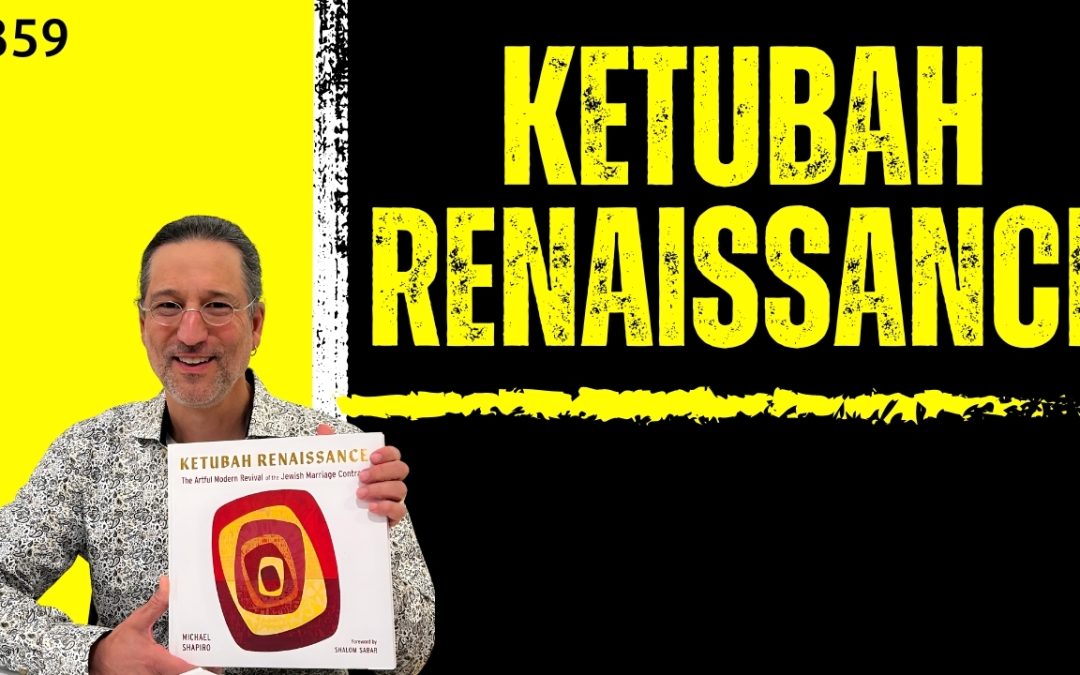
My book is called Ketubah Renaissance and it’s about the modern revival of this ancient art form in a North American context. And that really is what made my business possible.
James Kademan [00:03:07]:
That is incredible. It’s so funny something that I would consider this to be pretty major that I must be just living under a rock because I had never heard of these until connecting with you.
Michael Shapiro [00:03:18]:
Don’t feel too badly. I actually, until 1995, I wasn’t aware of this tradition either. So my parents and grandparents just had a simple Ketubah, a simple marriage document that was given to them by the rabbi just on a piece of paper filed away. So that was, you know, that was from the period time when this tradition of the beautifully decorated one had died out. So it was only in 1995, when I was studying in Jerusalem, networking with Judaica artists with an idea to open a shop when I came back to came back home to Canada that I met my first Ketubah artist. So don’t feel too bad because I didn’t know about this tradition either until, well, 30 years ago. And then I started the company.
James Kademan [00:04:01]:
Right on. That is awesome. So tell me about the contract itself right before we dive into the art, which is probably more fun. Part, tell me about the contract. Is this just a typical copy paste from every other marriage out there or is there some type of a conversation that happens between the parties, the husband, wife, as to what’s going to be included there?
Michael Shapiro [00:04:21]:
So yes and yes. So the handed down text has changed very little up until this period of the Ketubah revival. And it was a revolutionary text for its time. Imagine in biblical times a woman on her own, either because her husband died or because they became divorced. And divorce is allowed in Judaism, not encouraged, but it is allowed in Judaism. Women and her children on their own could be in serious financial straits. So this was a document that basically was a little bit like, if you will, a prenup slash insurance life insurance policy, which is that if she ended up on her own, she would have financial sum that would be available to her so that she and her children would be okay. That very legal text changed very little up until, as I said, the early 1970s.
Michael Shapiro [00:05:17]:
Around the time, and this was one of the contributing factors that opened up the, the revival of the art form, there started to be A proliferation of texts, and these included texts that went outside of the religious legal framework that the original text had come down. By that time, not all Jews were practicing sort of Orthodox Judaism. Their reform there was conservative and a whole range of texts that were more like what you’re mentioning in your question. Many of them now are more like love documents, commitments of shared value, rather than a legalistic sort of a document.
James Kademan [00:05:54]:
Gotcha. You know, it’s interesting because I’m thinking that the. The men are essentially assigned to support the women. So if the guy goes away for whatever reason, divorce, death, whatever woman is taken care of, does it also. I mean, we’re in a time now where that could be flipped, where the woman is the one making all the money. So does that go both ways?
Michael Shapiro [00:06:12]:
You know what? That’s a really interesting question. The traditional text, as far as I know, does not take that into account. And the more I would say contemporary texts, they don’t get into the financial end of it at all. So I guess in that circumstance, it would really be up to the state laws in terms when a couple divorces to make sure that they’re treating each other fairly versus the religious document requiring that.
James Kademan [00:06:43]:
Right on. And then last question, in regards to the contract itself, is this a legally binding document? So if some. A divorce happens, the spouse can say, hey, or the ex spouse can say, hey, this is. You owe me, according to this.
Michael Shapiro [00:06:58]:
Well, it’s. So it’s binding within a Jewish rabbinical court, if you will. It is. There have been some attempts to bring the ketubah to the so sort of, you know, courts of the state, so to speak. I’m not an expert in that field. I don’t know how successful they have been. So I guess the answer is kind of yes and kind of no.
James Kademan [00:07:20]:
All right, fair enough. Let’s get into the fun stuff. Tell me about the art side of these.
Michael Shapiro [00:07:25]:
Okay, so as I mentioned, the art form, it, you know, goes back about a thousand years. It’s a very rich art form. And one of the things that I find fascinating is the. That the ketubahs from different communities across time in different parts of the world typically were very heavily influenced and looked a lot like the art of the. Of the surrounding culture. So as an example, one of the areas where there was a real flowering of Ketubah art was in Venice and the other city states in the Italian peninsula. And these are gorgeous pieces of work. They tend to be fairly architectural in look.
Michael Shapiro [00:08:05]:
They’ll have peacocks on them, which is a symbol of fertility. And they’re very influenced by what you may imagine as an illuminated manuscript from the Christian tradition. By contrast, there are ketubahs that are from the Muslim world, for example, some beautiful ones from Isfahan and areas like what are currently Afghanistan, Iran, Persia, et cetera. And those look very much like the beautifully decorated Muslim manuscripts of the time. Nowadays they look like almost anything. And you know, as is documented in my book, they can look fairly traditional. On the one extreme to there’s one artist who has beautiful up close photographs of flowers and the ketuba text is superimposed very beautifully and effectively on top of that.
James Kademan [00:08:52]:
How cool is that? Tell me about the size I’m picturing. I guess I was picturing a contract, the letter size sheet of paper, but if it’s. I don’t think they have to be confined to that.
Michael Shapiro [00:09:03]:
Exactly. Typically these are, they are, if you will, art size. So something in the range of maybe 18 by 24 is a very common size, depending on the couple’s preferences. Nowadays at Companies such as Katuba.com or other artists who are producing, you know, work on their own, there usually is an option of going something like that, maybe to something smaller. For example, if you’re having a Manhattan apartment, you may not want some giant framed piece of art or much larger sizes for people who are in maybe a very large home and want to have a real, a real statement, real statement piece. So they vary in size, but in terms of how it’s used, it is at the ceremony, usually right before the ceremony, in a small room, an intimate space with usually the bride, the groom, the parents, maybe the maid of honor, the grooms, the groomsmen, it will be signed and then it is usually read out by the rabbi or the wedding officiant. And then afterwards it’s framed and hung in the home. So I think the size of it is very much determined by its sort of end use.
Michael Shapiro [00:10:04]:
If it’s will in the, if you will, in the place of honor, somewhere in the home, maybe in the living room, dining room. Some couples prefer to keep it in the bedroom.
James Kademan [00:10:12]:
Interesting. So you mentioned peacocks and flowers. How broad or how customized are we talking for the art thing? Is there anything that’s not allowed or anything that they must include this or anything of that nature on these?
Michael Shapiro [00:10:26]:
Okay, well, you ask really good questions. So traditionally in Judaism there is, you know, graven. Going back to one of the ten commandments against graven images, there is a tendency not to include human forms. However, in some notable exceptions, especially during this Italian flowering in the 16, 17, hundreds. There are some gorgeous ketubahs that include images of people. There’s even one that comes to mind where there’s images of nudes showing the Garden of Eden and there’s Adam and there’s Eve. And so that would not be the case in the Muslim world, where the prohibition against human forms was even more strictly observed in the surrounding culture. And those will tend to be more geometric in shape, although you will see animals, for example, in the ones from the Persian area, they’ll be the.
Michael Shapiro [00:11:20]:
Well, in addition to the rising sun, they’ll be the lions. These are symbols of Persian culture and history.
James Kademan [00:11:27]:
Interesting. Tell me about what gets included. Is this with you, the artist, and a conversation with the couple, or do you say, this is going to be it, or do they say, hey, throw some lines in there? How do you figure out what’s going to be in the art?
Michael Shapiro [00:11:43]:
Good question. So at the beginning of the revival of this art form, as I mentioned, which is the late 60s, early 1970s, it started off with the couple would meet with an artist. There would be a discussion of the couple’s values, maybe how they met, maybe where they met, and the artist would be listening for things that were important to them, including things between the lines, maybe that they weren’t speaking about, but that they got a sense of. And that would inform the imagery that that would go on the ketubah. That was how it got started. Then at a certain point there, the artists realized that there was an interest in for couples to be able to buy something that would be a little bit more affordable. So they started to produce reproductions of, I wouldn’t say generic designs, but designs that weren’t specific to the couple. And nowadays, if somebody comes to ketuba.com, they would go on our website, and we’ve got, I think, close to a thousand different designs, all based on originals from the artist.
Michael Shapiro [00:12:42]:
And the couple will choose one that speaks to them. And then the customization would be, once they choose the design, what text is most appropriate for them based on their level observance? Is it a Jewish couple, an interfaith couple, an LGBTQ couple? What size do they want? Do they want it printed on paper, canvas? So there’s some customization like that. There’s still some folks who prefer and would like to spend, make the investment, which is in the thousands of dollars for a custom piece made for them. But many are coming to places like ketuba.com and it’s hundreds of dollars to get an archival quality heirloom piece that is virtually indistinguishable from an original.
James Kademan [00:13:22]:
How cool is that? Let’s shift gears and talk about the medium. So is for an original, I want to talk about the original. Right. Because as an artist, you’re putting together this art. Is this, are we talking paint, charcoal pencil? What are we using?
Michael Shapiro [00:13:37]:
So the, the, the, the, the, the handed down tradition, if you will, of. I’ll start with the handed down tradition of illuminated manuscripts within the Jewish community, Christian community, Muslim community. So oftentimes the design is written and applied to a piece of parchment, which historically would, and even currently in some cases would be made from the hide of an animal. If it’s for a Jewish document, it would be from a kosher animal. So, you know, it might be from a sheep or a goat. And sometimes it’s referred to as vellum. And then the writing would be done again traditionally with. Usually it’s a goose quill where the end has been sharpened, and then inks that are made out of organic compounds and then gold leaf would be applied usually by hand.
Michael Shapiro [00:14:34]:
And that’s by the way, this term, illuminated manuscript, that’s where it comes from. Because these beautiful manuscript, handwritten manuscript, right. Would be embellished with gold and they would literally sparkle. So they were like illuminated. Nowadays, current technology is used and current printing and, and it’s, it’s, it’s typically done differently.
James Kademan [00:14:57]:
So I appreciate you telling me about the illuminated manuscript because I was thinking now we got LEDs and all that kind of stuff, you can light up anything. But a thousand years ago you had candles, and if you’re lighting candles by paper, you’re gonna have a bad day. So that makes sense with the gold leaf.
Michael Shapiro [00:15:12]:
Yeah. There’s one other thing I’ll mention too, which is one of the things that I’m proud of is that my team at our workshop has really done a great job of taking the current print on demand technology and marrying that, pardon the pun if you will, I love a dad joke. So I just thought it was the point. So marrying that with handwork. So whether it’s, whether it’s laser cutting the design or gold leaf be added, or Swarovski crystals applied by hand, My wife and I celebrated our 25th anniversary last summer and we decided it was time to get a commemorative ketubah. Doesn’t replace our original, but it’s a commemorative one. And that one has Swarovski crystals. And I’ll tell you, James, when I walk by it, it sparkles the crystals, somehow they just pick up the Regular light from the house, and there’s like, this sparkling as every time I walk by.
James Kademan [00:16:12]:
How cool is that? That is impressive, how, I guess, out of all the Jewish families that get married, how many of them are actually getting a ketubah? Is this everyone, or is this 90% or 50%?
Michael Shapiro [00:16:28]:
I would say that nowadays it’s probably in the realm of probably 90% of Jewish couples and maybe a similar number of interfaith couples, where one person is Jewish and the other person is not Jewish. There’s a great desire for couples of all stripes, so to speak, to connect with tradition because it’s a very beautiful part of the wedding. It’s also one of the few things that outlasts the wedding and is a permanent, you know, thing of beauty in the home, in keeping with the tradition of hidur mitzvah, which is the beautification of the commandments. So it’s something that is beautifully done and very lasting. And it’s also, thanks to current technology, it’s relatively inexpensive. If you think of somebody spending three or four hundred dollars for one of our beautiful ketubahs, well, their wedding probably costs 10,000, 25,000, a hundred thousand, like, depending. You know, it’s a drop in the bucket, and yet it has so much meaning in terms of beauty and longevity.
James Kademan [00:17:33]:
That is so true. I was just talking with a business friend of mine about her wedding that’s happening in. I don’t know, it was 10 months, 11 months, something like that. Because I asked her, like, hey, how’s married life? Because she was engaged six months ago, I just assumed she was married already because I haven’t been planning a wedding and, well, ever. So I just assumed she was married already. I didn’t know that people stayed engaged for a year and a half before they got married. And she was talking about all the planning and the cost, and I’m like, wow, okay, that’s not what I expected it to be. So I can understand a few hundred bucks.
James Kademan [00:18:15]:
Yeah, that’s a rounding error with some of these weddings. Holy cow.
Michael Shapiro [00:18:18]:
Yeah, it certainly can add up. And one of the things that I’m also proud of in terms of ketuba.com is, in addition to the cost, planning a wedding can be very stressful. There are some. It’s something that usually the couple, you know, there’s been some dream of it for years and years. In some cases since childhood, people have imagined what their wedding day was going to be like. On top of that, add the. The hopes, dreams, and expectations of parents, other family members. So it can be a very stressful thing.
Michael Shapiro [00:18:46]:
So I’m very proud of the fact that at least with the purchase of the ketuba, thanks to my team’s expertise, empathy, and real human customer service, the ketubah is one thing that you can just relax. It’s not something you’re going to have to worry about. We’re there to hold your hand every step of the way and make sure that everything is absolutely right.
James Kademan [00:19:08]:
That is incredible. Tell me about when the couple actually gets to see the ketubah. Is this something that waits until wedding day, or is it. Do they get to see it prior to that?
Michael Shapiro [00:19:17]:
So typically they’ll see it in advance. They’re usually ordering. I’d say about a month or two in advance is typical. Some couples will be planning further ahead and they’ll, you know, they’ll. They’ll. They’ll. It’s. It’s shipped to them.
Michael Shapiro [00:19:32]:
They will receive it. They’ll usually be having a look at it. So it’s not a surprise on the wedding day, but it is something that, you know, is. Is a special part of it. You know, opening it up again on the weather, wedding day, having it signed by, usually by witnesses, usually close friends. So it has a ceremonial element to it, even though it’s not being opened for the first time. Usually on the wedding day.
James Kademan [00:19:57]:
Right on. Tell me about the presentation. Once it’s signed. You made it sound like they hang up or they go in the house or bedroom or something of that nature. How are these ketubahs typically presented?
Michael Shapiro [00:20:08]:
Yeah, so usually they are read out. So during. Imagine the wedding ceremony. It’s a Jewish wedding ceremony. You may have, and your viewers may have seen one in movies. It takes place under a chuppah, which is a wedding canopy there at the end of it. Usually it’s usually the groom, but Cheryl and I, we both participate in this. Somebody stamps on a glass and everyone says, mazel tov.
Michael Shapiro [00:20:32]:
The part that isn’t always in the movies but is very much a fixture in most weddings these days is an artistic ketubah. So the rabbi will read out the ketubah, usually in English, rather always usually in Hebrew and in English as well. It’s read out under the canopy. And then oftentimes it’ll be mounted on an easel so that people can see it as they’re going to the reception or the dinner afterwards. And then after all that, the couple will take it generally to a local framer and have it beautifully framed so that they can hang it prominently in their home.
James Kademan [00:21:10]:
Gotcha. That is very cool. Tell me about the, when people are ordering this and I imagine you’re doing stuff with people all over the country. All over the world.
Michael Shapiro [00:21:19]:
All, all over the world. It very much is a, very much is an international business. Most of our customers are in the USA and in Canada, although we, we have many customers in the uk, Australia and everywhere in between. We’ve, we’ve had some very interesting orders over the years from places as far as Singapore, Hong Kong, India and you know, sometimes these are local people who are ordering, other times it’s expats who are living in a foreign country having their wedding there and want to, want to include this in their, in, in their ceremony.
James Kademan [00:21:56]:
That’s incredible. So tell me, how do you typically meet with them if they’re, let’s just say someone’s in Singapore, you’re in Toronto.
Michael Shapiro [00:22:02]:
Yeah. Now it’s. So when I first started I, I, so at the very beginning it was, it was just me. This is 1996. Okay. So I had a big black artist’s portfolio of samples and I would, couples would make an appointment, I would come to their home or apartment. I would open this large portfolio on their dining room table. They would select the design that they liked.
Michael Shapiro [00:22:28]:
And in those days, this is before the current print on demand technology was available. I would then collect the information from them and from their rabbi, especially for the Hebrew names. And then the artist or a local calligrapher would handwrite the names and location and date into spaces that had been left in the text from the get go. So there was very much a meeting in person in the early days, I think it was about 10 years ago when we actually stopped having meetings in person. Because what we found was, is that most customers preferred to come to our website, make their selection and check out. And nowadays there are many customers with whom we, we never, we never speak to them. We’ve worked very hard over the three decades to have our website interface be so user friendly that you don’t have to talk to us. Anybody who wants to, we’ve got live chat, of course, and we’ve got real human beings, you know, in, in, you know, in Toronto, which is where we’re based.
Michael Shapiro [00:23:29]:
And you know, we’re there, we’re there to help in any way that we
James Kademan [00:23:33]:
can that, you know, it’s interesting you mentioned the website and I want to ask you this question about your website because it’s just super attractive to me. The font that you used for the ketuba, it’s actually ketuba.com, it just shows that. So I don’t know if it’s. If you treat that it looks like almost as your logo. Is that a font that you created or what font is that? That is incredible looking font.
Michael Shapiro [00:23:56]:
That’s a good question. You’re Talking about the Gotuba.com logo like the top of the page. I don’t remember. I mean like I’m wearing a sweatshirt with our old logo. That is a new logo that we came up with. Well, came up with. We hired a graphic designer at the time to come up with it. I don’t.
Michael Shapiro [00:24:10]:
I think it’s based on a font and then parts of it were, are modified. The first letter K in particular was modified to be, to be very distinctive. But what I will say on the, on the, in an unrelated but related thing is the font of the English and Hebrew writing on the Ketubah is very special. It is a font that was developed by a calligrapher by the name of Patti Levy out of Baltimore, Maryland. And she had her font, rather had her calligraphy made into a font. These days there are companies called font foundries who can take an artist’s calligraphy and make it into a font. And we’ve licensed that exclusively from her. And, and that means that every Ketubah that we sell has a calligraphic font that is virtually indistinguishable from if the calligrapher had written it by hand.
James Kademan [00:25:04]:
Wow, that is amazing. Tell me, you mentioned both Hebrew and English. Is it written, are Ketubah’s written in both Hebrew and English?
Michael Shapiro [00:25:12]:
They usually are. Usually it’s Hebrew first followed by English. Having said that, there are some couples, particularly among the more traditional, who will only have a Hebrew text. And in fact, interestingly, the handed down text, it looks like Hebrew as in it’s in the Hebrew Alphabet, but it’s actually in a different but related language called Aramaic, which was the spoken language in the land of Israel around the time that the Ketubah was codified. It’s also the language that would have been spoken in the times of early Christianity. So likely the language that, that, that Jesus and his contemporaries would, would have been speaking. And so that, that is actually so for very traditional couples will have that handed down text in Aramaic without English. Now for many contemporary couples, it doesn’t have to just be Hebrew and English.
Michael Shapiro [00:26:11]:
We’ve done some with other languages, Hebrew and Spanish. We’ve had some really interesting ones, for example, Hebrew and, and Mandarin. For a couple who had a, you know, you know had some background related to, to Chinese tradition and culture.
James Kademan [00:26:28]:
Has it been tough to translate or find a translator to go from Hebrew to insert language here?
Michael Shapiro [00:26:35]:
Well, usually. So we, we, we, we are able to provide a service. So some couples prefer to write their own text and I would, I would. And we actually about a. I don’t think it was soon after ChatGPT came out, we had some fun and we put together a tool which is on the ketuba.com website and it is an AI powered ketuba text writing assistant. And it asks you a couple of questions and you can type in about your shared values, what you love about each other, and then you can select a style ranging from traditional ketuba text to Shakespearean sonnet and it will come up with something for you. It’s surprising how good it is. Some people are using that for fun, others are using it more seriously.
Michael Shapiro [00:27:19]:
But my point is that whether you use AI or not, if couples provide us with an English text, we are very capable of translating into Hebrew. If it’s a question of translating it to other languages, we usually look to the couple to provide us with the text. Any language that they can put on a word document, whether it’s a right to left language or a left or right, a left to right language, we can accommodate it, we can typeset it beautifully onto their ketuba.
James Kademan [00:27:48]:
That is cool. I love it. Let’s shift gears into your business. 30 years ago you started this business. How do you get into the ketuba business or even decide that you want to be in the ketuba business?
Michael Shapiro [00:28:01]:
Well, I’ll tell you, James, at the beginning, there were lots of people who told me I was crazy to try and start a business that was just about ketubahs. Now, as you may recall, earlier in the conversation, I mentioned that in 1995 I had left my corporate job. After business school, I was recruited to work at Procter and Gamble. I spent a couple of years there, learned a ton. I was in there what they call their advertising department, which most of us know is brand management. Learned a ton about strategic business thinking and marketing. But I was really too much of a creative spirit for that sort of a corporate space. So I left there.
Michael Shapiro [00:28:37]:
I went to Jerusalem to study at a yeshiva, a place of traditional Jewish learning. And while I was there, I started networking with artists because I, I wanted to start a business when I came back home and I had a couple of ideas and one of them was to open a brick and mortar gallery of fine art Judaica now you’ll notice that I said a brick and mortar gallery. Well, of course I’d have to say that, except in 1995 you didn’t have to say that because the Internet was
James Kademan [00:29:05]:
so brick and mortar.
Michael Shapiro [00:29:06]:
The only that that was all there was. So I, I came back home, I started, I, I, I, I engaged the services of a, of a real estate agent and we started to look at renting storefront and I started to do calculations about how much it would cost me to invest in inventory and so on and so on. And I was starting to get not quite cold feet, but a little bit concerned about what I was getting myself into. Then I bumped into a very old friend, a man by the name of Scott Wiseman. We had been best friends in elementary school. And he said to me, michael, you know, I’m leaving social work and I’m going to start building websites. Now, I barely knew what a website was, but long story short, I became his first customer. He built a very simple but effective HTML website, which you can still see today if you go on the Wayback Machine.
Michael Shapiro [00:29:53]:
There’s an Internet archive that’s wonderful. It shows up. We launched it July of 96. It shows up for the first time on that archive in December of 96. It’s got a little animation and at the beginning the company was called Ketuba Ketuba. And even though I had registered the domain name ketuba.com in the spring of 96, I didn’t yet have the idea of. It was much later actually that one of my managers at the time had a brilliant idea. She said, you know what, I don’t know, I don’t know if you want to hear this, I don’t know if this is a stupid idea.
Michael Shapiro [00:30:29]:
But I said, well, there’s no there, there are no dumb ideas. And her thought was, well, instead of having our company called Ketuba Ketuba and our website [email protected], why don’t we just call the whole thing ketuba.com? so that was when we pivoted. We decided to make our entire website and online retail offering under the name ketuba.com ketuba ketuba. There’s still other aspects of the business, the wholesale side, whatnot, under Ketuba. But it all came together under ketuba.com.
James Kademan [00:31:00]:
that is incredible. So all because you had a buddy, essentially, they knew how to build websites way back in 95.
Michael Shapiro [00:31:06]:
Yes, because I was young and naive and passionate enough to go ahead in spite of the naysayers. And do something that I thought was a good idea, that I thought was interesting, that tapped into my personal interests and give it a try. Now I had that. Luckily I was, as I mentioned, I was young. I also was single and I was able to live at a buddy’s house very inexpensively. So my costs were very low. So that was a real advantage.
James Kademan [00:31:39]:
Tell me, you were in the marketing game with Proctor and Gamble before. So how did you market ketuba.com originally?
Michael Shapiro [00:31:45]:
Way back then in the early days. So as I mentioned, we, we put up a website July of 96, but it was a website that really nobody came to. It wasn’t an E commerce site and also nobody was online at that time. This is, this is before Google. Right. Just to put it, to put it in perspective.
James Kademan [00:32:00]:
Oh yeah, I remember.
Michael Shapiro [00:32:02]:
So I’m, I’m, it’s word of mouth within my local community. I’m making appointments, not many, but appointments to go with my black artist portfolio and whatnot. The next step was that I took out a small ad in some Jewish magazines that, that helped me to, to, to get the word out people. I had, I also, I had a toll free number. It didn’t ring much but I did have a toll free number. So that, so that, you know, and that number was on the little ads in the magazine so people could call me. And then a little bit later on I started to, I would, I would rent a booth in the artists section of Jewish conventions. So whether it was like a convention related to one of the streams of Judaism.
Michael Shapiro [00:32:46]:
So for example the Women’s League for Conservative Judaism, they had a, every two years they had a beautiful convention. So I remember I went down, it was in the Catskills at an old school Catskills hotel. And I had a little booth and I’m showing my ketubahs. So it was one thing after another trying to use my wits to think about how do I get, how do I get word out. Nice.
James Kademan [00:33:16]:
So when you first got the website going, you got this 800 number. Were you offering to meet with people over the phone or how did that work?
Michael Shapiro [00:33:26]:
Yes. So for local customers, they could make an appointment and I would come to their home. For others who were outside of the city, they could certainly phone us and it would be an, we had photos. I mean as I mentioned, we have almost a thousand [email protected] today at that, at that first website, I think it had something like two or three dozen designs so they could get a visual of what they were, you know, what designs were available. There would be examples of the texts that were available which were pretty limited in those days. Usually there might be, at that time there might be around maybe three different texts. So, you know, likely orthodox, the orthodox text, conservative text, reform text. Nowadays there’s 30 plus texts, right, you know, which which include interfaith text, LGBTQ texts.
Michael Shapiro [00:34:15]:
We also have texts for, you know, couples where one or one or both of, you know, of the individuals identify as non binary. So there’s all, you know, so there, there wasn’t as much choice. Also at that time, in the very beginning, it was simpler, I would say, in terms of options because we were not yet producing the ketubas. We were essentially a reseller, if you will, of limited edition print runs that artists were making themselves. And one thing that I’ll say that’s kind of cool about that is so in nine times out of 10, the product never came through our offices. We had a website. If you imagine sort of a triangle where there’s like, you know, here, here, here’s our website. The customer is looking at the website.
Michael Shapiro [00:35:00]:
They send us their information. So the names, the date, et cetera, in English and Hebrew, they fax it to us on a form. We send that information to the artist. The artist fills in the information and drop ships it to complete the triangle, if you will, directly to the customer. So in Those early days, nine times out of 10, we didn’t actually ever have a hand directly on the product. Nowadays, for the last 15 plus years or so, we’ve got a full in house production facility where everything, we license the art from the artist, the artists are paid a royalty for each one that we sell, but it’s all produced in house.
James Kademan [00:35:38]:
Gotcha. Well, that’s super cool. Tell me, back in 1995, how did you accept payment? I mean, we’re talking about the crazy infancy of the Internet as far as the public is concerned.
Michael Shapiro [00:35:50]:
Yes, it was very clunky and very early. We would fax people a form which would itemize what they were buying, how much it was. They would then need to sign and date it, fax it back to us. We would manually process the order. And there was an extra step too, because most of our customers were and are in the US but we’re physically in Canada. And so we didn’t, at that time we didn’t have access to US dollar credit card processing. So imagine that, you know, the people are placing an order and we need to charge them $100. Well, we would then try and figure out, well, how much, how many Canadian Dollars, should we charge them so that it’s going to end up being approximately the right.
Michael Shapiro [00:36:34]:
Without. Without overcharging them and so on their credit card bill, Instead of seeing $100, they might see 9833 or 9,957 or what have you. So it was a very manual and pretty clunky approach. It was about, I think it was within about four years. It was around, I think it was around the year 2000 that we graduated to a rudimentary e commerce site and there was a company called CyberCash which made online credit card payments possible. That was a huge step forward. But up until then it was faxes, back and forth, manual processing, the whole nine yards.
James Kademan [00:37:08]:
Oh, that’s funny. Tell me about the artists themselves. How do you find artists? How did you find them initially that were worthy of what you’re looking for? And then how have you found them throughout the years?
Michael Shapiro [00:37:19]:
Great question. The very first artists I met in Israel, as I mentioned, there was a man by the name. I didn’t say his name, I don’t think a man by the name of Arden Halter, who lives in a place called Pardeschana, not too far from Haifa in Israel. And. And through my networking with Judaica Artists in Israel, June of 95, I arrived at his front door and he showed me his work and I was immediately smitten. So initially it was through word of mouth. When I came back, I traveled quite extensively throughout the US and I met artists literally from coast to coast. Nowadays, while of course, we’re always on the lookout for new artists that are producing high quality work that’s different than what we already have and that we think will appeal to our customers.
Michael Shapiro [00:38:07]:
Artists will approach us. We’re a big fish in a small pond. I mean, ketuba.com is not a giant enterprise, but in the realm of ketubahs, we are well known enough that we do have artists approaching us.
James Kademan [00:38:22]:
That’s a. I would call that a good problem to have.
Michael Shapiro [00:38:25]:
Yes, agreed.
James Kademan [00:38:27]:
Tell me about. So an artist produces. I don’t know if it’d be a print, but let’s just say an original one. Do they then take that to a photographer or a print shop of some kind that takes the super fancy picture of it, or how does that work?
Michael Shapiro [00:38:43]:
That is the beauty of our process. We basically, the artists who work with us love it because they get to do what they love to do, which is to produce the original. They then hand it off and we take care of everything else and Then essentially forevermore, afterwards, every quarter they get, they get a check in the mail. These days it’s a digital deposit, but they get paid a royalty for their work ongoingly. It used to be they would send us the original. We worked with a fine art scanner in town here that specialized in the scanning. So we took care of that. We absorbed the cost of that, the color correction and all that.
Michael Shapiro [00:39:24]:
Nowadays there are more artists who will send us digital files. Although much of much of the art is still done originally by hand, but the technology has, has, has made that a little bit smoother. But artists love that they can do the art and then leave the rest to us.
James Kademan [00:39:42]:
That is super cool. Are the prints typically limited? So every artist piece of art, is it limited to 50 or 200 or 5,000 or something like that? Or is it just however many people? Like that one. Just plug away.
Michael Shapiro [00:39:57]:
Our editions are limited. They’re printed in limited edition. Everyone comes with a little pencil number on it that tells you what number it is. And our editions are numbered up to 433. Now that’s an odd number, right? Like, why 433? So I’m very interested in Jewish tradition and ways that we can somehow convey that and incorporate that into our product. So this is a very subtle way. Most people don’t even know why, but I’ll let you in on the secret. There is a tradition that actually has kabbalistic roots where each letter of the Hebrew Alphabet was assigned a number by the sages and the numer.
Michael Shapiro [00:40:34]:
So the numerical value of the word ketubah in Hebrew, if you add up the letters, it adds up to 433. So we thought, wow, let’s do editions of 433. We do actually have some of our premium products that are in smaller numbers. There’s some that are as low as 36. 36 also has significance because it’s a multiple of 18. 18 has a numerical value of the word chai, which means life. So but mostly it’s this, this sort of quirky but meaningful number. 433.
James Kademan [00:41:07]:
Nice. That’s clever. I love little things like that that are just subtle, subtle hints or cues that once you understand em, you’re like, oh, that’s amazing. But before that you’re just like 133. Whatever, some number.
Michael Shapiro [00:41:19]:
I think it, I think it adds something to the product. It also makes my job fun. I just turned 60 and I was 30 when I started this. So I literally have spent half my life on this. And James, people have been asking me, are we Thinking about retiring. I’m just, I’m excited about the next 30 years. Like, what are we going to do? How are we going to innovate? And in fact, there are a number of things that we’re working on which I’m very excited about that are, you know, build on, complement and somewhat, I would say, really quite new.
James Kademan [00:41:48]:
That is awesome. Tell me about the business. When you first started it 30 years ago, you’re sleeping on your friend’s couch. At what point or how long did it take for it to actually be profitable where you’re like, hey, I actually got a real business here that’s making money.
Michael Shapiro [00:42:02]:
I think it was year three where we were. I made a point of saying we from the beginning because I thought it sounded bigger and it sounded good. I think it was year three where I was breaking even. In the meantime, I was doing some small marketing consulting gigs on the side to just make ends meet and make sure I could pay my buddy the rent. I mean, he was charging me 300amonth. I think after the first year, he said, okay, you know what? I think I have to charge you a bit more. So then it was $600 a month. And that included, it actually included two bedrooms, one room that I slept in, the other room where I had my little computer, my toll free number.
Michael Shapiro [00:42:42]:
He was gone most of the time because he worked for the Boston Consulting Group. So he’s leaving in the middle of the night Monday morning and coming back late Friday night.
James Kademan [00:42:51]:
Sounds like the best roommate.
Michael Shapiro [00:42:53]:
He was terrific. He was really, really wonderful. He actually had a pet name for me. He called me Rabbi. I mean, I’m not a rabbi, but because I was so into my, into my tradition and building this business rooted in Jewish culture, he would, he called me Rabbi.
James Kademan [00:43:08]:
Oh, that’s funny. That is funny. Tell me about your first employee.
Michael Shapiro [00:43:14]:
So my first employee was a friend who had skill, had some time available, and she would basically come in in the morning. I was still living in his house. She would come in. What has to get done? Oh, catalogs need to be stuffed into envelopes. Oh, there’s some ketubas that need to be. And that was a big. That was. Going from zero to one, as you and your listeners may know, is a very big step, but it was a critical step.
Michael Shapiro [00:43:39]:
And I would say that while I have many skills as a entrepreneur, it would take me an entire morning to stuff our little catalogs into the envelopes and put the stamps on and put the labels on. Or at that point I was probably handwritten, writing the addresses. Whereas, you know, somebody else would be able to do that in, you know, in 10 minutes or 20 minutes. So it was a very early lesson about the importance of delegating and also having people with complementary skills. But what I would say also is from that very first employee and up to this day, there is a common denominator, which is everybody who works for me has a head on their shoulders, is thinking about a little bit, how can I learn, how can I improve and feels good about contributing and making a difference for our customers there.
James Kademan [00:44:30]:
I love it. I love it. That’s a very, very big deal when you’re hiring people. It’s always the joke, I guess, that good help is hard to find, but bad help you can find no problem. Tell me about the, the point. I guess when you first started your business, you get your new employee. The Internet shifted a little bit between, let’s call it 95 and 2000, 2001, you got the dot com crash because everybody was putting dot com after everything. Tell me about that shift.
James Kademan [00:44:59]:
Was there ever a point when you were scared of your, of your business succeeding or not succeeding, or a point where you’re like, oh, we got this in the bag. This is easy now.
Michael Shapiro [00:45:09]:
So, yeah, so with the bursting of the Internet bubble, I remember being aware of it, but that was not one of the times when I would say I was scared or scared for the business. And I think it’s because the business was still quite small. And I made a point from the beginning of growing organically, so I didn’t have a giant amount of debt. And I was, you know, many entrepreneurs have a big vision and want to build a billion dollar company and will want to grow very quickly. There’s a place for that. And I have a lot of respect for folks who are able to do that. That wasn’t my vision. And I think because of slow methodical growth that even with going through the bursting of the Internet bubble, at that point, I wasn’t fully reliant on the Internet, for one thing.
Michael Shapiro [00:46:02]:
And the second thing was because of the methodical growth and not having accumulated a ton of debt, it wasn’t one of the points when I was fearful for the business.
James Kademan [00:46:13]:
Gotcha. So over the course of 30 years, I don’t know any metrics on marriage as far as if there’s ebbs and flows or if the same amount of people get married every year. Have there been lean years and other years where you’re just like, oh my gosh, everybody in the world’s getting married?
Michael Shapiro [00:46:29]:
Well, I’ll talk first about, I guess, the most notable year, which was a very lean year. So, you know, your listeners will recall In March of 2020, when the pandemic was declared and everything was being shut down, that was a time literally from one week to the next where our orders tanked by 80% and.
James Kademan [00:46:50]:
Oh, wow.
Michael Shapiro [00:46:52]:
Yeah, and that was, that was a scary time. And it, you know, it, it continued through the, you know, like say the early year or two of the pandemic orders were way down. I’m proud of the fact that I made a commitment to my team that I would do everything in my power during the uncertain times ahead to provide ongoing employment and financial security. And I’m, I, I was. I did a calculation about how far in the whole I would be willing to go personally to make that possible. I was then very fortunate that the government of Canada stepped in and provided wage subsidies, which really helped to make it possible beyond, I think, what I would have been able to sustain and kept everybody fully employed, most from home, of course, full time, at full salary throughout the pandemic and made really good use of the time because, of course, with the order numbers being so low, everyone had time to get to the projects that we don’t usually get to. And I believe that because of that, we came out of the pandemic stronger and then were ready by, I think it was around year three or so that we saw a record year of sales where thankfully those folks who had canceled or delayed their weddings then had their weddings and came back to us. And this is an important distinction between what was available for my business versus, say, hotels, restaurants that just could not, you can’t recoup that lost revenue or those meals that weren’t ordered, the orders came back.
Michael Shapiro [00:48:26]:
And we then had one record year. And then after that, we were sort of back to more or less where we had been before with some, you know, with some ongoing, steady, steady growth.
James Kademan [00:48:37]:
That is interesting. You know, it’s funny because you remind me of back, way back when I used to deliver beer. And if there was a holiday or something of that nature, like the beer had to be delivered, people drank the beer, but on a holiday, we were closed. Which just meant that either one day, pre or post, you were working twice as hard for the essentially the same amount of money. And it was funny because you realize, like, there’s certain industries where that’s just the thing. Trash pickup is one of them where I’m thinking of. And there’s other industries like what you got going on when there’s a lull. There’s a compensation for that lull after that.
James Kademan [00:49:15]:
And you can make it work and essentially make your money, make your business go over the course of time, it averages out. But other industries, there is no average. There’s a finite level of time. So it’s very interesting that way.
Michael Shapiro [00:49:29]:
And of course, though, when you’re in the middle of that downturn, you don’t know, Right. You kind of hope, because as entrepreneurs, we need to hope, but we also need to plan. And you don’t know if that wave is going to right itself, if those customers will come back or if purchase patterns or preference will change in the meantime. So there certainly is risk and concern. But thankfully, and I’m very grateful to my staff and to our customers that those orders did come back eventually.
James Kademan [00:50:01]:
You know, it’s interesting you mentioned doing the math, because I remember doing that math. I want to say almost weekly, certainly monthly, to figure out how long can I afford to keep us in business if there’s this drop in revenue or if this drop in revenue sustains or grows? Like everything was so touch and go and you’re like, okay, I don’t see this lasting forever, because if it lasts forever, we have other problems as a society. But how long is that Runway to figure out what can we afford to do and how much. How much am I willing to spend to keep the business in business? Which is a very, very, very bad math problem to have to do. Not a fan of that math problem, but, yeah, I can. I definitely remember doing that way back when. So matter out of that hole. That was fun.
Michael Shapiro [00:50:53]:
Well, and I think I was just gonna say that one. One thing that grounded me as I was making that, that agonizing calculation was reminded myself that as an entrepreneur, I benefit from the upsides in a way that an employee doesn’t. So. And this was a time when I also, you know, I take the hit for the downsides in a way that an employee doesn’t. So my feeling is, over time, this is what I signed up for. And it’s not all going to be beautiful, you know, gravy train and, you know, roses and all that sort of thing. And this is this. This is part of the.
Michael Shapiro [00:51:36]:
There. There are the ups and the downs, and I’m. I’m. I’m here. I’m here through. Through both of those.
James Kademan [00:51:42]:
Oh, absolutely. Totally. Yeah. It’s the. That’s the game, right? That’s the game of entrepreneurship. And not everybody necessarily has the stomach for it.
Michael Shapiro [00:51:51]:
Exactly. And sometimes I also felt like I owed it to my. Owed it to my team who really were there day in and day out before and continued to be there throughout. And, you know, most of them have, are still with me to this day. Some, some. It’s. I think it’s been 18 years for my longest standing employee. I’ve got others that are at 15 years, 12 years.
Michael Shapiro [00:52:12]:
Yes, I’m very, very.
James Kademan [00:52:14]:
That’s incredible. Is your team all in Toronto or are they remote?
Michael Shapiro [00:52:21]:
Yeah, so we’re all.
James Kademan [00:52:21]:
We’re.
Michael Shapiro [00:52:22]:
Well, we’re all, all in Toronto, except there are. I’ve got three team members who are working, who are working physically in the office. That’s where the production happens. The printing, the laser cutting, the shipping. And then I’ve got the rest of the team. There are five other team members who are working from their homes, but all.
James Kademan [00:52:43]:
Yeah, gotcha. That is super cool. So, I guess, Michael, before we take off here, is there anything that you would, I guess, inspiring things or things that you learned that you wish every entrepreneur would know? You’ve been in business 30 years, which is a huge. Oh, my gosh, it’s a huge milestone. So congrats for that. What is some advice that you would give an entrepreneur that was just starting out?
Michael Shapiro [00:53:09]:
Well, number one is follow your passion and look for a pain point. When I first started the revival of the art, ketuba was already 25 years in. Most people wanted one and it was difficult for them to find the artists. So there was a pain point that aligned with my passion. Second thing would be play the long game, if you will, as in just set your eyes on something and keep at it. A lot of people said to me at the beginning, you can’t possibly have such a focused business just on ketubas. And I stuck with it. And over the long term, and over five or six different total rebuilds of my website kept asking the question, how can I make this better for my customers? So I think those would be my main takeaway.
Michael Shapiro [00:54:00]:
And the last thing would be to keep innovating. As I mentioned, I wrote a book on the topic which is published by the Jewish Publication Society. We recently launched a Jewish lifestyle magazine which helps to make us relevant and provide value to our customers when it’s not time for a ketubah. We just launched a line of artistic family trees which are perfect for when your, you know, your mother, father, grandfather has their 75th, 90th birthday. What do you, what do you get someone who has everything. So I think it would be around, keep growing, keep innovating and keep Keep trying to do, do better by. By your customers, your staff and your suppliers.
James Kademan [00:54:43]:
That’s incredible. I love it. Tell me, Michael, really quick about your book. What made you decide to write and publish a book?
Michael Shapiro [00:54:50]:
Sure. So it was a labor of love. It was over a period of time, starting in 2013. I wrote an email to David Moss, who was an artist who came and presented one evening when I was studying in Jerusalem back in 95. And I said to him, you know, I think it’s been about 50 years since you started to take the lead and revive this art form. I think there should be an exhibition on this topic. And so at first it was about an exhibition, then it morphed into a book. I started doing my research and it’s come full circle in a nice way, is that today I now have a traveling exhibition that ties in with the book.
Michael Shapiro [00:55:33]:
And so when I’m going to speak about my book, oftentimes the host organization says they order the exhibition in advance. And so it’s a beautiful, immersive, you know, visual example of the art form so that people can interact with it as I’m speaking about it.
James Kademan [00:55:51]:
How cool is that?
Michael Shapiro [00:55:52]:
Yeah, so it’s been quite a journey.
James Kademan [00:55:56]:
That’s incredible. Who is your target market for the book? Is that people that are interested in ketubahs, as far as getting one and want to learn more of a history or who’s. Who’s reading a book like this?
Michael Shapiro [00:56:09]:
Yeah, so it would. It is so engaged couples, their parents and grandparents who were very, you know, for whom the ketubah is something very relevant and topical. Also people who are interested in Jewish art and cultural developments because it’s a huge. It really is a revolutionary sort of incident, if you will, in contemporary artistic and cultural development over the last. Over the last 60 years. And also there’s also some interest among rabbis, cantors and wedding officiants who are also very much in space and have a great interest in. In. In Katubas.
James Kademan [00:56:49]:
How cool is that? Michael, you have an amazing business going on. 30 years in business. You got the book, you got the website that started way back in 95 when websites were, we’ll call it rare, I guess. And you kept the same domain for 30 years. That, I mean, holy cow, that’s. That’s longer than I think, just about any website that I can think of, maybe save for whoever keeps track of websites. So that’s amazing. You got a good thing going on.
Michael Shapiro [00:57:20]:
Thank you. Thank you so much. What a pleasure to talk with you today. I really enjoyed it.
James Kademan [00:57:24]:
Yeah, likewise. Michael, can you tell us that website one more time?
Michael Shapiro [00:57:28]:
Sure. So it’s ketubah.com. it’s spelled k e t like tom u be like boy a h.comketuba.com is
James Kademan [00:57:38]:
there, I should ask you, is there some kind of history of that word or what it means? Or is that just a word something came up with?
Michael Shapiro [00:57:44]:
Absolutely. It’s a Hebrew word. It means written. It comes from the same root as some modern Hebrew words, like the word for letter is mikhtav. So it means it’s a written document and it’s called a written document in part to distinguish it from the verbal agreements that would have happened in biblical times. Earlier times, there would have been an agreement oftentimes between the two families. So this is a written document that formalized the agreement and as I mentioned earlier, provided very important protections for the wife in the event that she would find herself on her own.
James Kademan [00:58:19]:
That is clever. I love it. This has been Authentic Business Adventures, the business program that brings you the struggle stories and triumphant successes of business owners across the land. My name is James Kiedeman and Authentic Business Adventures is brought to you by Calls On Call, offering call answering and receptionist services for service businesses across the country. On the web at https://callsoncall.com and of course, the Bold Business Book, a book for the entrepreneur and all of us available wherever fine books are sold, as well as Live Switch. With Live Switch, you can take live videos with your clients to save you time and money. Check them out at https://liveswitch.com if you’re listening or watching this on the web. If you could do us a huge favor, give it a big old thumbs up, subscribe and of course share it with your entrepreneurial friends.
James Kademan [00:59:03]:
And if you have a ketubah, let us know what you included on there. That may be kind of fun. We’d like to thank your wonderful listeners as well as our guest Michael Shapiro of Ketubah.com and Michael, thank you so much for being on the show.
Michael Shapiro [00:59:16]:
James, thank you so, so much.
James Kademan [00:59:19]:
Past episodes can be found morning, noon and night at the podcast link found https://drawincustomers.com thank you for joining us. We will see you next week. I want you to stay awesome and if you do nothing else, enjoy your business.
https://ketubah.com/